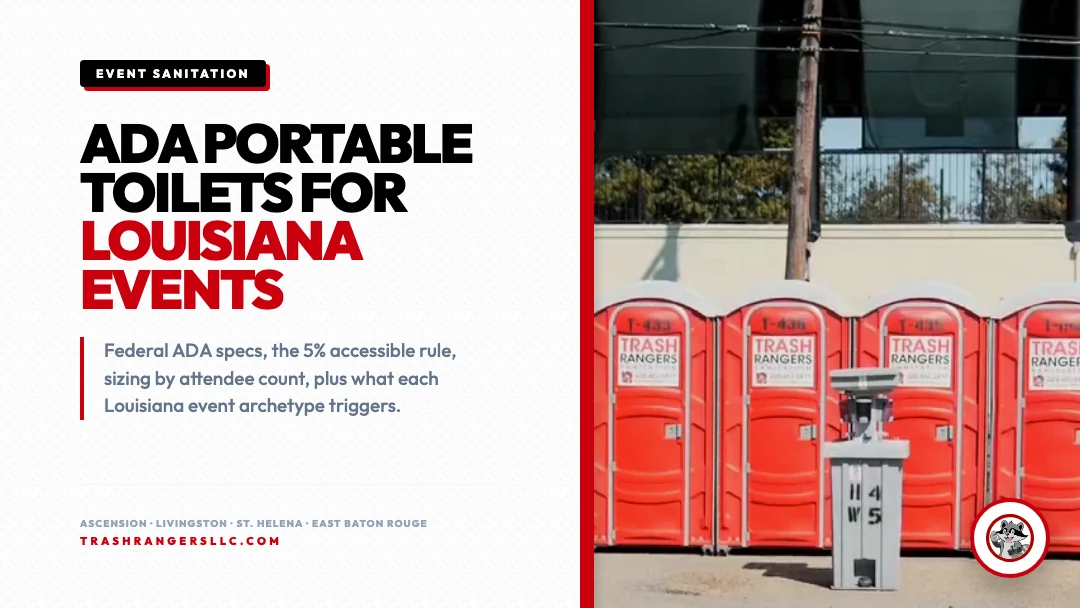

Louisiana’s outdoor event calendar runs hard. Crawfish boils peak February through May. Mardi Gras parade-staging requires temporary sanitation across multiple weeks. LSU home football weekends produce dozens of tailgate operations. The summer wedding season clusters in June through August. Bayou Country Superfest, the Jambalaya Festival in Gonzales, parish-park events, krewe staging, every one of these needs portable toilet rental, and every one carries regulatory weight that most planners don’t realize until something goes wrong.
The compliance layers stack: federal ADA accessibility requirements for any “public accommodation” event, Louisiana’s Title 51 Sanitary Code under the Louisiana Department of Health Bureau of Sanitarian Services, parish-level permits and food-service overlays, and industry-standard ratios from the Portable Sanitation Association International (PSAI). This guide is the regulated-facts walkthrough for Louisiana event operators, what the specs actually are, which events trigger which rules, and how to size a rental that doesn’t fail inspection or fail the guests.
Federal ADA 2010 Standards Section 213 and US Access Board Chapter 6 guidance require that at least 5% of portable toilets in each cluster at events open to the public be ADA-compliant, with a minimum of one accessible unit. The accessible unit must meet specific dimensional standards: 60-inch turning space, 32-inch minimum clear door width, threshold no more than 0.5 inch high, 17-19 inch toilet seat height, grab bars at 33-36 inches, and maximum ramp slope of 1:12 if not at-grade. Industry sizing per PSAI guidance is roughly 1 standard portable toilet per 50 guests for a 4-hour event, with 15-20% more capacity if alcohol is served and 1 hand-wash station per 4 toilets when food is served. Title II covers state and local government events (parish parks, LSU, public festivals); Title III covers commercial venues and ticketed events. Truly private events (an invitation-only family crawfish boil at a private residence) generally aren’t covered, but the moment an event is open to the public or commercial, most weddings booked at a public venue, every ticketed festival, every parish-permitted event, ADA applies. Don’t guess; verify with the ADA Information Line at 800-514-0301 or call counsel.
TLDR:
- The 5% rule, US Access Board Chapter 6 requires at least 5% of portable toilets per cluster to be ADA-compliant, minimum one accessible unit per cluster.
- Disability prevalence is not a corner case, CDC data shows 28.7% of US adults report a disability, with 70 million-plus US adults, including 14% with cognitive disability, 12.2% with mobility disability, and 43.9% of adults 65+ reporting any disability.
- Federal ADA specs are specific and binding, 60-inch turning radius, 32-inch door clearance, 0.5-inch maximum threshold, 17-19 inch seat height, 33-36 inch grab bar height, 1:12 maximum ramp slope. Per the 2010 ADA Standards for Accessible Design.
- Industry sizing is roughly 1 portable per 50 guests for 4-hour events, scaling with duration. Add 15-20% capacity for alcohol service. Add 1 hand-wash station per 4 toilets when food is served. Per PSAI guidance.
- Louisiana adds Title 51, the Louisiana Sanitary Code at Title 51 under LDH governs portable sanitation at events. Parish permits and food-service overlays layer on top.
- Private vs. public matters, Title II (government) and Title III (commercial / public accommodation) cover most events; invitation-only private events at private residences generally don’t. Religious organizations are exempt from Title III. Don’t self-diagnose; verify with the ADA Information Line (800-514-0301).
Who Needs to Plan for ADA-Compliant Portable Toilets?
ADA applicability runs on two main titles relevant to event sanitation. Title II covers state and local government services and programs, that includes parish-park events, LSU game-day operations, public-festival staging, city-permitted events on public squares, and any event organized by or held on the premises of a state agency. Title II coverage is essentially always-on for these contexts.
Title III covers “places of public accommodation”, privately-owned facilities that serve the public, including hotels, banquet halls, restaurants, ticketed-festival venues, and event spaces that regularly host public events. The Title III trigger is whether the event is open to the public or held at a commercially-operated venue. Religious organizations are exempt from Title III.
The grey area is private events at private residences. An invitation-only family crawfish boil at a private home, Title III generally doesn’t attach. A backyard wedding with 150 guests at a residential property, same answer for the residence itself, though the rented portable sanitation vendor still must comply. The complication: many “private” venues that rent regularly to the public lose their exemption. A private hunting club that opens its grounds to outside weddings for a fee is renting as a public accommodation.
The practical rule for Louisiana event planners: assume ADA applies and rent ADA-compliant units unless your event is genuinely private, invitation-only, and at a true private residence. Even then, including at least one accessible unit is a guest-experience advantage, not a compliance burden. The 5%-of-units rule applies whenever you fall under Title II or Title III, and a 100-guest event typically needs 2-3 standard portable toilets, so the minimum-one-accessible-unit floor often kicks in regardless.
When in doubt, call the ADA Information Line at 800-514-0301 for free guidance. Don’t self-diagnose Title III exemption.
What the ADA Specs Actually Require
The 2010 ADA Standards for Accessible Design set the dimensional and operational requirements for accessible toilet facilities. For portable toilets used at temporary events, US Access Board Chapter 6 applies. The specs aren’t suggestions; they’re enforceable federal standards.
The regulated facts every Louisiana event operator should know by heart:
The placement rule trips up the most planners. Setting your accessible units off to the side, behind the main service area, or at the far end of the venue technically meets the 5% headcount but fails the integration requirement, accessible units must be co-located with the standard units in the main cluster. The intent is that disabled guests don’t have to traverse a separate path; they queue at the same cluster as everyone else.
The ramp question only applies when the units sit above grade. A standard portable toilet on a level lawn or paved surface needs no ramp. A unit set on a trailer bed, on a step-up platform, or on uneven ground requires a 1:12 maximum slope ramp that meets the threshold spec at the entry.
The International Symbol of Access, the white wheelchair on blue background, must be visible on each accessible unit. Standard ADA units come pre-marked from most rental fleets; double-check this before delivery.
How Many Portable Toilets Do You Actually Need?
PSAI guidance for portable toilet sizing is the industry-standard reference. The basic math: roughly 1 portable toilet per 50 guests for a 4-hour event, scaling with both attendance and duration. Longer events need proportionally more units because the same toilet serves more uses; alcohol service compounds the math.
The minimum-ADA column shows that even a 50-attendee event needs 1 accessible unit when standard sizing calls for any portables at all. The 5% rule and the 1-minimum floor combine: until the event exceeds 20 standard units (roughly 1,000+ attendees at 4-6 hours), the minimum is 1 ADA unit. Above 20 standard units, the 5% rule starts to push above the floor.
For practical planning: the ADA unit is almost never the binding constraint. Standard-unit sizing for the event size is what drives most of the rental cost. Adding 1 ADA unit instead of 1 standard unit is a marginal incremental cost, and it’s required.
For the per-event arithmetic on specific Louisiana event types, see the parallel TR guides: portable toilet planning for Gonzales events covers crawfish-boil specifics, and portable toilets vs. restroom trailers in Gonzales covers the trailer-upgrade decision.
Hand-Wash Stations and Food Service
Any event serving food triggers a separate sanitation rule: portable hand-wash stations co-located with the toilet cluster. The general industry rule is 1 hand-wash station per 4 portable toilets when food is served, though specific ratios vary by jurisdiction.
The Louisiana-specific number, the exact ratio required under Title 51 of the Louisiana Sanitary Code, should be verified with the LDH Bureau of Sanitarian Services for your event’s parish before committing the rental order. Some Louisiana parishes layer additional requirements on top of state code, particularly for events serving raw seafood (which most crawfish boils do) or events with on-site cooking. The general industry 1:4 ratio is a safe default; the specific parish requirement may be tighter.
The food-service permit itself is a separate item. Louisiana RS 40:31.37 sets a $25 fee for temporary event food permits, filed with the parish health unit. The food permit and the portable sanitation rental aren’t the same thing, but they tend to fire together, most Louisiana parishes won’t issue the food permit if portable sanitation doesn’t meet the minimum guest-count ratio for the event size.
Louisiana Event Archetypes (Sizing Examples)
The math gets practical when applied to actual Louisiana event types. These are operator-built examples based on PSAI ratios, the US Access Board 5% rule, and typical Louisiana event timing. They’re starting points; specific parish overlays may require adjustments.
Crawfish boil, 75 guests, 5-hour event, food (crawfish), no alcohol restriction: – 2 standard portables (PSAI sizing for 75 guests over 5 hours) – 1 ADA-compliant unit (minimum floor) – 1 hand-wash station (food served, 1 per 4 toilet ratio rounded up) – Total: 2 standard + 1 ADA + 1 hand-wash
Backyard wedding, 150 guests, 5-hour event, food, alcohol: – 3 standard portables base; +20% for alcohol = 4 standard – 1 ADA-compliant unit – 1 hand-wash station – Total: 4 standard + 1 ADA + 1 hand-wash
Festival or krewe staging, 2,500 guests, 8-hour event, food, alcohol: – 38 standard portables base; +20% for alcohol = 46 standard – 2 ADA-compliant units (5% of 46 = 2.3, round up to acknowledge cluster integration) – 12 hand-wash stations – Total: 46 standard + 2 ADA + 12 hand-wash
LSU game-day tailgate operation, 500 guests, 6-hour event, food, alcohol: – 7 standard portables base; +20% for alcohol = 8 standard – 1 ADA-compliant unit – 2 hand-wash stations – Total: 8 standard + 1 ADA + 2 hand-wash
These are starting points. The single largest sizing variable beyond attendee count is service quality expectation, corporate events, weddings, and high-end private parties typically over-size by 20-30% to keep wait times short and units fresher. Public festivals and tailgate operations typically run leaner on the assumption that some queueing is expected.
When a Restroom Trailer Is the Better Call
Standalone portable toilets handle most Louisiana event scenarios. But for high-end events, weddings booked at upscale venues, corporate events with executive attendance, multi-day festivals, a restroom trailer often becomes the right rental.
The differences that matter:
- Climate control, restroom trailers have HVAC; portable units don’t. South Louisiana in July is the use case where this matters most.
- Running water and flush toilets, trailers have plumbing; standard portables use blue chemical fluid.
- Multiple stalls per trailer, typical restroom trailers handle 6-12 simultaneous users; standalone portables handle 1.
- ADA-compliant trailer configurations, most restroom trailer fleets include ADA-equipped versions with the dimensional specs above plus interior grab bars, accessible ramp, and roll-in entry.
- Cost differential, trailer rentals run 4-8x the per-day cost of standalone portables. Worth it for the use cases where guest experience matters; overkill for a crawfish boil.
The clean decision rule: portable toilets for tailgates, festivals, crawfish boils, and most parish events; restroom trailers for weddings, corporate events, and any multi-day event where guests expect indoor-restroom-equivalent experience. For the deeper comparison see portable toilets vs. restroom trailers in Gonzales.
The Louisiana Regulatory Layer
Federal ADA + PSAI industry standards cover the universal requirements. Louisiana adds its own layer through Title 51 of the Louisiana Sanitary Code, administered by the LDH Bureau of Sanitarian Services. Title 51 governs portable sanitation at events with specific provisions for:
- Permit requirements for events above a certain guest-count threshold
- Hand-wash-station ratios at food-service events
- Effluent disposal requirements (where can portable toilet waste actually be dumped?)
- Inspection authority, LDH sanitarians can inspect any public event
- Food-service overlay rules for raw-seafood events (crawfish boils trigger this)
The practical advice for Louisiana event operators: call your parish health unit before placing the rental order for any event above 100 guests. The parish health unit can confirm the exact Title 51 + parish overlay requirements for your specific event location. The LDH state-level page provides general guidance; parish-by-parish specifics vary.
For Ascension Parish events, contact the Ascension Parish Health Unit. For East Baton Rouge events, contact the EBR City-Parish Public Health Division. For Livingston Parish events, contact Livingston Parish government. Each parish has its own overlay rules and own permit fees beyond the state RS 40:31.37 $25 food permit fee.
Common Questions About ADA Portable Toilet Rental in Louisiana
These are the questions Louisiana event planners ask in the first phone call. Some have clean regulatory answers; others depend on parish-by-parish specifics that need verification with the local health unit.
Do I need ADA portable toilets at a private wedding?
If the wedding is at a true private residence with invitation-only guests, generally no, Title III public-accommodation rules typically don’t attach. But if you’ve rented a venue, hired a commercial caterer, or are booking a vendor who deals primarily with public-facing events, the venue or vendor falls under Title III and your event inherits the coverage. In practice, including at least one ADA unit is a guest-experience advantage and an inclusive-event signal regardless of strict legal compliance. Don’t self-diagnose Title III exemption; call the ADA Information Line at 800-514-0301 for free guidance.
How many portable toilets does a Louisiana crawfish boil need?
For a 75-guest crawfish boil running 5 hours, PSAI guidance supports 2 standard portables. Per the US Access Board 5% rule with 1-minimum floor, add 1 ADA-compliant unit. Per industry standard for food service, add 1 hand-wash station. Total: 2 standard + 1 ADA + 1 hand-wash. Crawfish boils don’t typically need alcohol-service upcharge unless the event is BYOB-heavy. Adjust up for longer events or larger guest counts.
Where does the portable toilet waste actually go?
In Louisiana, portable sanitation waste is regulated under Title 51 effluent disposal rules. Licensed haulers transport to permitted disposal sites, typically municipal wastewater treatment plants under specific dump-station agreements. Reputable Louisiana operators document their disposal route and disposal-site permits. Unlicensed haulers occasionally dump in unauthorized locations; this is a serious public-health violation. Always rent from a Louisiana-licensed operator.
What’s the difference between an ADA portable toilet and a “standard” one?
Standard portables have approximately 36-by-48-inch interior dimensions with a step-up entry and grab handle. ADA portables have approximately 60-by-72-inch interior dimensions (to meet the 60-inch turning radius), 32-inch minimum door clearance, level-entry threshold (max 0.5 inch), 17-19 inch toilet seat height, 33-36 inch grab bars on both sides, and the International Symbol of Access on the exterior. Per the 2010 ADA Standards Section 213 and US Access Board Chapter 6.
Does the ADA unit count toward my total toilet count?
Yes. The 5% rule means at least 5% of total portables at each cluster must be accessible, with a 1-minimum floor, but the accessible units count toward the total guest-capacity calculation. If PSAI sizing calls for 10 portables and the 5% rule requires 1 ADA, the math is 9 standard + 1 ADA = 10 total. Not 10 standard + 1 ADA = 11.
How early should I book portable toilets for a Louisiana event?
For festivals and weddings during peak season (March-October), book 8-12 weeks ahead. Crawfish-boil season (February-May) sees particularly tight availability for the larger fleets. Last-minute bookings inside 2 weeks of the event are possible but typically come with a delivery surcharge and limited size selection. ADA-compliant units in particular are inventory-constrained, booking ahead is the difference between getting a properly accessible cluster and improvising at delivery.
Planning a Louisiana event and need ADA-compliant portable toilets?
Trash Rangers serves the Baton Rouge, Ascension Parish, Livingston Parish, and surrounding-area event circuit with portable toilet and restroom-trailer rentals, including fully ADA-compliant units that meet the 2010 ADA Standards specs and the US Access Board 5%-per-cluster rule. Same-week delivery available during peak season when booking allows.
About the author
Jake Poche, Owner, Trash Rangers. Trash Rangers of Louisiana, LLC is a Baton Rouge-area waste services company serving residential trash collection, commercial dumpster rental, and event sanitation across Ascension Parish, East Baton Rouge, and the surrounding parishes. The company is registered as a Louisiana State Contractor (License #71067), holds an A+ BBB rating, and has been operating since August 2020. Learn more about the company at trashrangersllc.com or get in touch through the contact page.