
How Many Portable Toilets Do You Need for Your Guest Count?
Plan on one portable toilet per 50 to 75 guests for an event running up to four hours. That works out to roughly 4 to 5 units for 200 guests, 8 to 10 for 500, and 18 to 20 for 1,000. Louisiana’s legal minimum is far lower, one toilet per 200 people, and it only applies to gatherings of 500 or more people lasting four or more hours. Meeting the legal floor and keeping lines short are two different goals.
TLDR:
- Plan one portable toilet per 50 to 75 guests for events up to four hours.
- 200 guests: about 4 to 5 units. 500 guests: about 8 to 10. 1,000 guests: about 18 to 20.
- Louisiana’s mass gathering rule starts at 500 or more people for four or more hours. Below that, the state ratio does not apply to your event.
- Where it does apply, the legal minimum is one toilet per 200 persons or fractional part thereof.
- Urinals may be substituted for up to one-third of the required toilets.
- Add 15 to 20 percent more units when alcohol is served.
- Include at least one ADA-compliant unit at any public event.
- Events past one day need scheduled servicing, usually early each morning before gates open.
Two things surprise most organizers. The first is that Louisiana’s headline ratio may not apply to their event at all. The second is that where it does apply, the legal minimum is nowhere near enough to keep a line from forming.
Both are worth understanding before you order, because the number that keeps your guests comfortable is not the number the state requires.
Working out a count for your event? Tell us the guest number, the hours, and if you are serving alcohol. We will size the units and the handwash stations for the site.
The Legal Minimum and the Practical Number
Louisiana’s sanitary code sets restroom ratios for what it calls a mass gathering. Section XXV-101 defines that as “a group of 500 or more persons assembled together at any one time, for four or more hours.” A 200-guest wedding reception does not meet that definition, so the state ratio is not what governs it.
Where the rule does apply, Section XXV-117 is short and specific:
Toilets. At the rate of 1 for each 200 persons or fractional part thereof.
The same section allows a substitution worth knowing about: “Urinals (men’s) and sanistands (women’s) may be substituted for up to one-third of the required number of toilets.” It also requires that facilities be “conveniently accessible and well identified” and that each toilet have “a continuous supply of toilet paper.”
Run the numbers and the gap becomes obvious. At 1,000 guests, the legal floor is five toilets. Five toilets for a thousand people would produce a line you could see from the parking lot. The state minimum is a public health backstop, not a comfort standard, and planning to it is how events end up with complaints.
Our planning ratio is one unit per 50 to 75 guests for a four-hour event. Here is how the two compare.
| Guest count | Event length | Louisiana legal minimum | What we plan for |
|---|---|---|---|
| 200 | Up to 4 hours | Not a mass gathering under 500 guests | 4 to 5 units |
| 500 | Up to 4 hours | 3 units | 8 to 10 units |
| 1,000 | Up to 4 hours | 5 units | 18 to 20 units |
Guest Count Guide for Louisiana Events
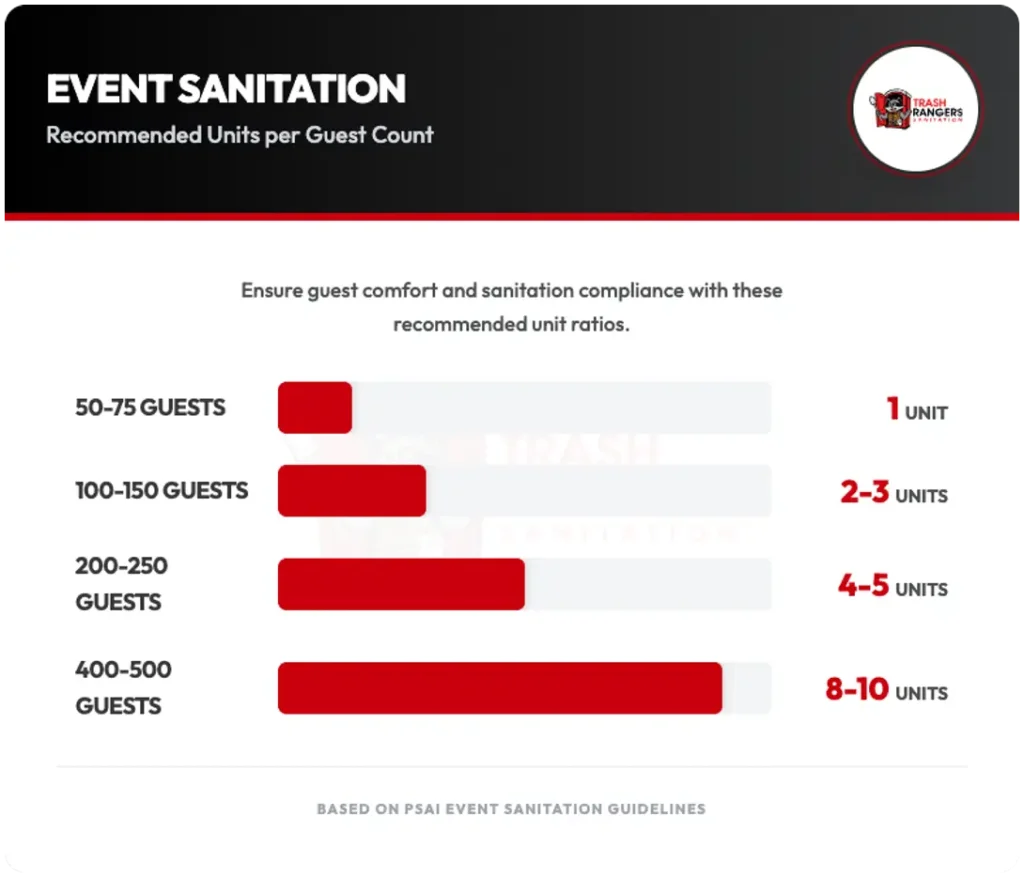
| Guest Count | Event Length | Minimum Toilets |
|---|---|---|
| 50 to 75 | Up to 4 hours | 1 unit |
| 100 to 150 | Up to 4 hours | 2 to 3 units |
| 200 to 250 | Up to 4 hours | 4 to 5 units |
| 400 to 500 | Up to 4 hours | 8 to 10 units |
| 750 | Up to 4 hours | 14 to 15 units |
| 1,000 | Up to 4 hours | 18 to 20 units |
These are starting points for a four-hour window. Three things push the number up from here: alcohol, a longer run time, and a site where guests cannot easily reach a second bank of units.
How Event Length Changes the Count
The ratios above assume up to four hours. Guests at a two-hour ribbon cutting use a restroom far less than guests at an eight-hour festival, and the count has to follow the hours rather than the headcount alone.
A useful way to think about it: a crowd of 500 for eight hours behaves more like a crowd of 700 or 800 for four. If your event runs a full day, plan the count against the longer window and add a mid-event service if the schedule allows it.
Why Alcohol Service Requires More Toilets
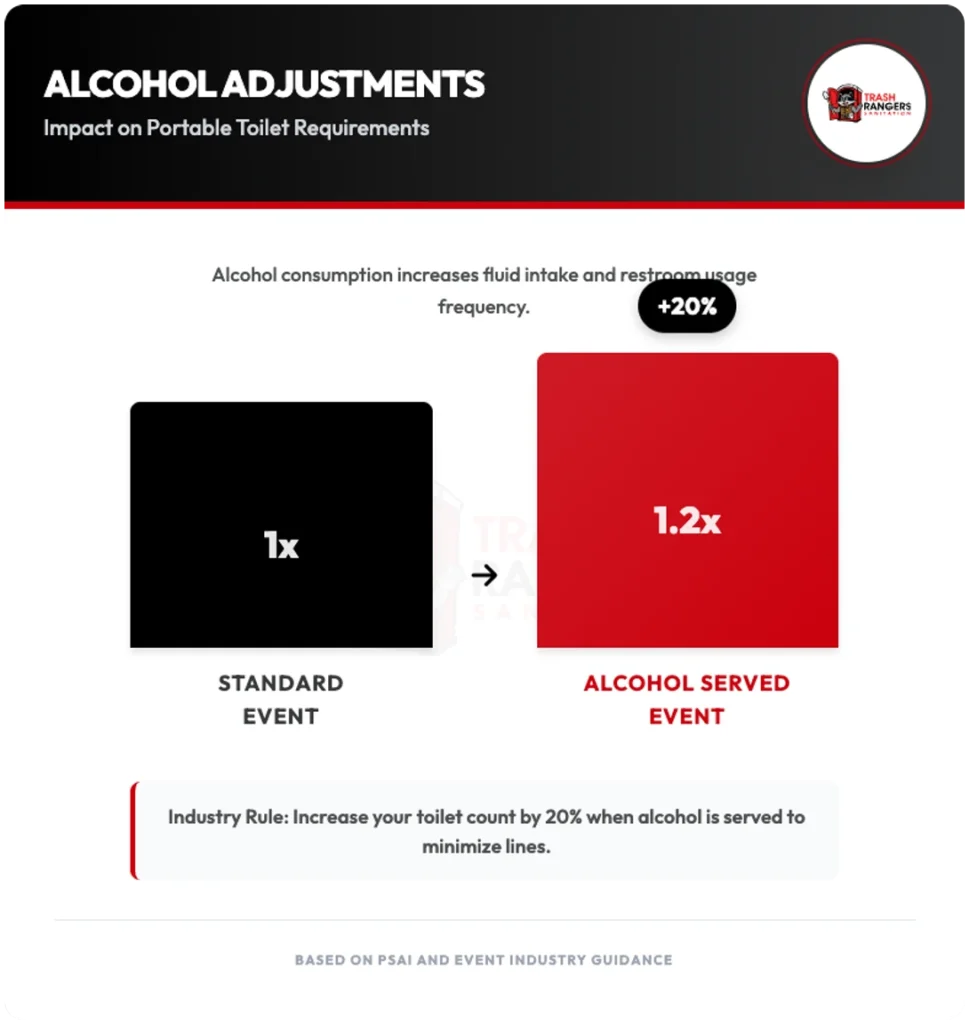
When alcohol is served, restroom use rises and it concentrates into peaks. Most planners raise the unit count by 15 to 20 percent to keep lines short during those peaks.
Heat compounds it. An August event in Ascension Parish with drink service will move more people through the units than the same event in November, and the units themselves need servicing sooner.
ADA Units Are Part of the Count, Not an Add-On
Any public event should include at least one ADA-compliant unit, and larger crowds, older guests, or family-heavy events usually need more than one.
- At least one ADA unit for any public event
- More where guests skew older, or the event draws families and special-needs groups
- Placed on level, unobstructed ground with a clear approach path
Accessible units need to sit where someone can actually reach them, which usually means a firm surface and a route that does not cross the busiest pedestrian lane.
Handwash Stations and Lighting
Handwash stations belong near food and drink service, not only beside the restroom bank. If your event has food vendors, that placement is part of their setup as much as yours. For the count itself, see our guide to how many hand washing stations you need.
For anything running into the evening, plan lighting around the restroom area. String or tower lighting near the units solves a safety problem and a comfort problem at the same time, and it is far easier to arrange in advance than on the night.
Service Frequency for Multi-Day Events
Events lasting more than one day need servicing to keep units clean, stocked, and usable. Large multi-day events typically schedule servicing early each morning before gates open.
Tell us the gate hours when you book. The servicing window has to fit inside the times a truck can actually reach the units.
Two Worked Examples
A 200-guest outdoor wedding, five hours, bar service. Start at 4 to 5 units for the guest count. Add 15 to 20 percent for the bar, which takes it to 5 or 6. One of those is an ADA unit, and a handwash station goes near the bar and the catering area. The mass gathering rule does not apply at this size, so the count is driven entirely by guest comfort.
A one-day festival, 3,000 guests, eight hours, food and alcohol. The base count lands around 26 to 30 units. Heat and drink service push most planners to 32 to 34, distributed across the main stage, the food court, vendor row, and the entry. The state minimum here would be 15 units, which shows how far the legal floor sits below a workable plan.
Checklist Before You Order
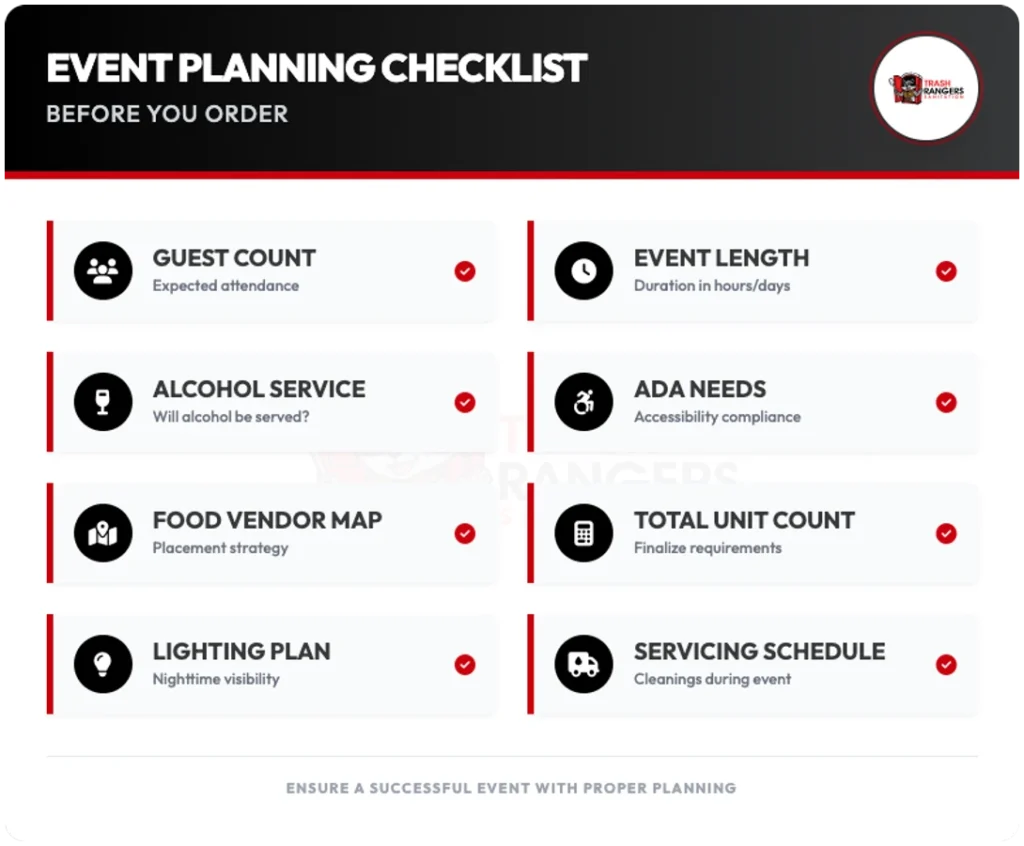
- Final guest count confirmed
- Event length and hourly schedule defined
- Alcohol service decided
- Food vendor zone mapped
- Standard, ADA, and handwash totals set
- Placement map sketched with access paths
- Lighting plan for evening events
- Servicing plan for multi-day events
Event Portable Toilet Questions
What organizers ask us most before booking units for weddings, festivals, tournaments, and Lamar Dixon shows.
How many portable toilets do I need for 500 guests?
Plan on 8 to 10 units for a four-hour event, more if you are serving alcohol or running longer. Louisiana’s legal minimum at 500 guests is 3 units, since the mass gathering rule requires one toilet per 200 persons or fractional part thereof, but that floor is a public health backstop rather than a comfort standard.
How many portable toilets do I need for 1,000 guests?
Around 18 to 20 units for a four-hour event. The state legal minimum would be 5. The gap between those two numbers is the difference between meeting the code and having no line at the units.
Does the Louisiana rule apply to a 200-person event?
No. The state defines a mass gathering as 500 or more persons assembled at one time for four or more hours. A 200-guest event falls outside that definition, so the count is driven by guest comfort rather than the state ratio.
Can I use urinals to reduce the toilet count?
In part. Louisiana allows urinals and sanistands to be substituted for up to one-third of the required number of toilets, and counts twenty-four inches of trough urinal as the equivalent of one urinal or toilet.
How does alcohol affect restroom planning?
It raises use and concentrates it into peaks. Add 15 to 20 percent more units when alcohol is served, and expect to service them sooner in summer heat.
Do events require ADA portable toilets?
Any public event should include at least one ADA-compliant unit, and events with older or family-heavy attendance should add more. Place them on level ground with a clear approach path.
Should I rent portable toilets if the venue has indoor restrooms?
Usually yes. Indoor restrooms help, but portable units reduce bottlenecks and cover outdoor zones, vendor areas, and field layouts. If you are weighing standard units against a more comfortable upgrade, read portable toilets vs restroom trailers.
Do multi-day events need servicing?
Yes. Multi-day events need pump-outs and restocking to keep units usable for large crowds, usually scheduled early each morning before gates open.
Planning an event in Ascension, Livingston, or East Baton Rouge Parish? Give us the guest count, the hours, and the site, and we will put together the restroom plan and the quote.