
Planning Restrooms for an Outdoor Wedding in South Louisiana
Most South Louisiana weddings fall below the state’s mass gathering threshold, so there is no legal minimum number of restrooms. That puts the whole decision on you and your planner. Guest count, how long the bar is open, meal service, venue plumbing, and accessibility are what actually set the number, not a rule you can look up.
TLDR:
- Louisiana’s mass gathering standard applies to 500 or more people assembled for four hours or more, so most weddings are not covered by it at all.
- Where it does apply, the state schedule is 1 toilet per 200 people, which is a legal floor and not a comfort target.
- A barn or farm venue with one interior restroom is the most common trouble spot in Ascension and Livingston Parishes.
- Duration and the bar drive usage harder than raw headcount does.
- Placement matters as much as count: lighting, level ground, and distance from the dance floor.
- Accessibility is a planning item, not an afterthought, and it has its own specifications.
- Delivery and pickup timing needs to work around vendor load-in, photos, and the venue’s own access rules.
South Louisiana wedding season runs long, and the venues that photograph best are often the ones with the least plumbing. A restored barn off Highway 44, a family property in Prairieville, a pecan grove outside Walker: they give you the look, and they hand you a sanitation problem the venue coordinator may not raise until late in the process. This checklist is what we walk couples and planners through before an event date gets locked.
Getting close on a date? Tell us the venue, the guest count, and how long the reception runs. We will scope the restroom plan and tell you straight what the property actually needs.
Does Louisiana Require a Certain Number of Restrooms?
This is the first question almost every couple asks, and the answer is not what people expect. For most weddings, no.
Louisiana’s sanitary code regulates mass gatherings, which it defines as “a group of 500 or more persons assembled together at any one time, for four or more hours, for a meeting, festival, fair, social gathering, or other similar purposes at a site other than a permanent place of assembly,” per Louisiana Administrative Code Title 51, Part XXV. A 150-guest wedding on family land does not meet that definition. Neither does a 300-guest reception.
When an event *is* a mass gathering, the schedule in Section XXV-117 requires toilets “at the rate of 1 for each 200 persons or fractional part thereof.” Urinals may substitute for up to one-third of the required number, facilities must be “conveniently accessible and well identified,” and each toilet must have “a continuous supply of toilet paper.”
Read that ratio carefully before you borrow it. One unit per 200 people is a public health floor written for festivals and fairs, not a standard for a six-hour reception with an open bar. Planning a wedding to that number is how you end up with a line running past the photographer during the toast.
So if the state is not setting your number, what should? The next section covers the variables that actually move it.
What Actually Drives the Number
Headcount is where planning starts, but it is rarely what causes problems. These five factors move the requirement more than guest count alone.
Duration. A four-hour reception and a seven-hour event with a welcome hour are not the same job. Usage compounds the longer people stay.
The bar. An open bar running all night changes restroom traffic substantially compared to a beer-and-wine toast. Plan for it honestly rather than optimistically.
Meal service. A seated dinner concentrates traffic into predictable waves, right after courses and right before dancing. A grazing station spreads it out.
Venue plumbing. The single most important question: how many working restrooms does the property already have, and are guests actually allowed to use them? “There is a bathroom in the house” is not a plan when 140 people are outside.
Guest mix. Older relatives, small children, and anyone with mobility needs change both the count and the placement.
Our portable toilet planning guide walks through the sizing conversation in more detail, and the jobsite sizing breakdown shows how the same variables work on longer-running sites.
Standard Units or a Restroom Trailer?
This is the decision most couples agonize over, and the honest answer depends on the venue more than the budget.
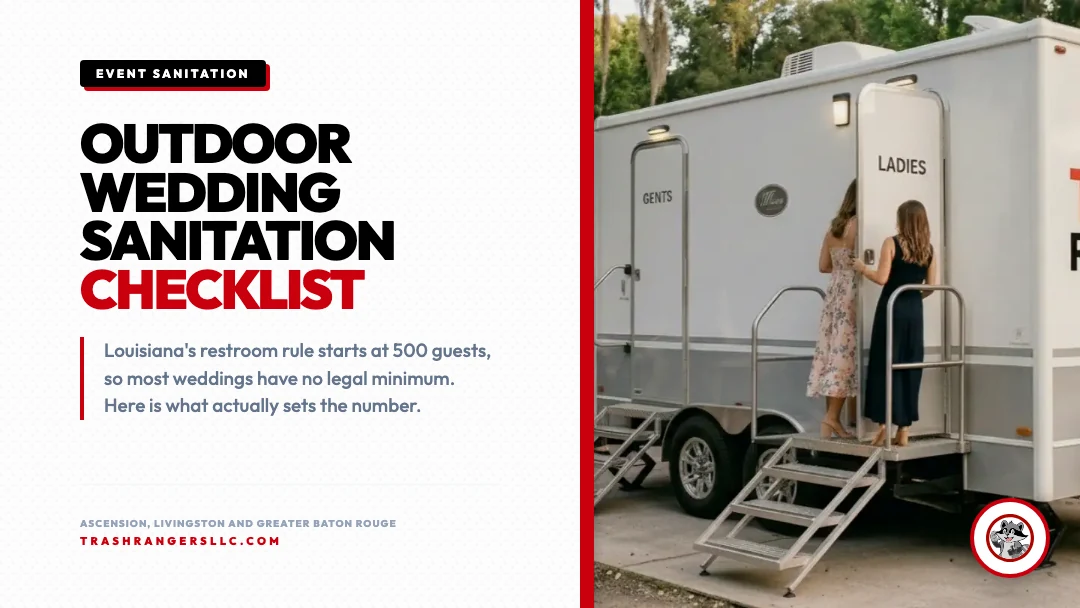
A restroom trailer reads as an indoor bathroom: climate control, running water, real lighting, a mirror. At a wedding where guests are dressed up and the reception runs into the night, that experience difference is what people remember. Standard units are the practical choice for overflow, for staff and vendors, and for properties where a trailer cannot physically get in.
That last point catches people. A trailer needs level ground, adequate access for the delivery vehicle, and depending on the model, a power source. A soft field after a week of South Louisiana rain is a real constraint, not a hypothetical one.
We wrote a full comparison in portable toilets versus restroom trailers, which covers comfort, logistics, and budget side by side. Many weddings end up using both.
Not sure your venue can take a trailer? We will look at access, ground conditions, and power before anything gets reserved, so there are no surprises on delivery day.
Where the Units Go
Placement is the part couples think about last and notice first. A well-chosen spot disappears from the day. A bad one shows up in the photos.
Keep units close enough that guests will actually walk to them, which usually means within sight of the reception area but not adjacent to it. Put them downwind, off the main sightlines, and screened where you can. Firm, level ground matters for both delivery and for guests in heels.
Lighting is the most commonly missed item. A unit that was easy to find at 5 p.m. is invisible at 9 p.m. on a rural property with no ambient light. Plan a path guests can follow after dark.
Keep them well away from food service and the cake table, and give the delivery vehicle a route in and out that does not cross the ceremony site.
Accessibility Is Not Optional
Every wedding has guests who need an accessible unit, and this is the item most often caught too late to fix.
Accessible units have their own dimensional and clearance specifications, and they need a firm, level path to reach them. Gravel and thick grass are barriers even when the unit itself is compliant. Placement matters as much as the unit choice.
We cover the specifications in detail in our guide to ADA portable toilet rental for Louisiana events, including how the requirement scales with event size. If your venue is in the Baton Rouge area specifically, the Baton Rouge events version covers local considerations.
Timing, Delivery, and the Details That Get Missed
The logistics around the units cause more day-of stress than the units themselves. Sort these early.
Confirm delivery well ahead of vendor load-in so the units are placed before tents, tables, and the dance floor go in. Once a tent is staked, your placement options shrink. Ask the venue about access restrictions, gate codes, or hours that limit when a truck can come through.
Decide who is responsible for the units during the event. For a long reception, someone should be checking supplies. Confirm the pickup window too, especially if the venue requires the property clear by a set time the next morning.
Finally, write the sanitation plan into your day-of timeline the same way you would catering or the band. It is a vendor delivery with dependencies, not a detail that sorts itself out.
Questions South Louisiana Couples Ask About Wedding Restrooms
These come up on nearly every wedding call we take. Short answers here, and we will get specific once we know the venue.
How many portable toilets do I need for my wedding?
There is no single formula, and any vendor who gives you one without asking about your venue is guessing. Guest count, reception length, bar service, existing plumbing, and accessibility needs all change the answer. Give us those five things and we will scope it properly.
Does Louisiana legally require restrooms at a private wedding?
Usually not. The state’s mass gathering standard applies to 500 or more people assembled for four or more hours at a non-permanent venue. Most weddings fall below that, which means no state minimum applies, and the decision is entirely yours and your planner’s.
Is a restroom trailer worth it for a wedding?
For a dressed-up evening reception, most couples say yes. A trailer offers climate control, running water, and real lighting, which is a noticeably different guest experience. The constraint is typically the venue itself, since trailers require level ground, delivery access, and sometimes power.
When should the units be delivered?
Before your other vendors load in. Once tents, tables, and a dance floor are in place, your placement options narrow considerably. Confirm the delivery window and any venue gate or access restrictions as soon as the date is locked.
What about accessible units for elderly or disabled guests?
Plan for them from the start. Accessible units have specific clearance requirements and require a firm, level path to reach them, which rules out deep gravel and thick grass. Placement is as important as having the unit on site.
Do we need hand-washing stations too?
If you are serving food, plan on it. Guests notice, and it matters more at outdoor venues where the nearest sink may be inside a house that is closed to guests. We will include it in the scope when we look at your setup.
Let’s scope your venue before the date gets locked. Tell us the property, the headcount, and how long the reception runs, and we will put together a restroom plan that fits the day instead of a guess.