
How Many Hand Washing Stations Do You Need?
No Louisiana or federal rule gives a hand washing station count for a public event or a construction site. The number most planners start from comes from the portable sanitation industry’s own standard: the 2016 edition of ANSI/PSAI Z4.3 calls for one hand wash station for every 1 to 10 toilets, and one more for each additional 10. Food vendors provide their own handwashing under Louisiana’s sanitary code. On job sites, OSHA requires washing facilities when crews handle harmful substances, and waterless cleaner alone usually does not satisfy that rule.
TLDR:
- Louisiana’s mass gathering rules set a toilet count (1 per 200 people) but say nothing about hand washing stations.
- The industry baseline is 1 hand wash station per 1 to 10 toilets, then 1 more for each additional 10, from the 2016 edition of ANSI/PSAI Z4.3.
- Each food vendor handles its own handwashing: a plumbed sink when pressurized water is available, two buckets when it is not.
- OSHA’s construction rule requires washing facilities near the work when crews apply paint, coatings, herbicides, or insecticides, or handle other harmful contaminants.
- OSHA has said waterless hand cleaner and rags would typically not be enough to remove those contaminants.
- CDC says soap and water beat hand sanitizer when hands are visibly dirty or greasy.
- Placement matters as much as the count: put stations by the restrooms and by the food.
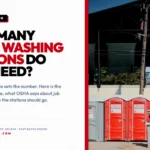
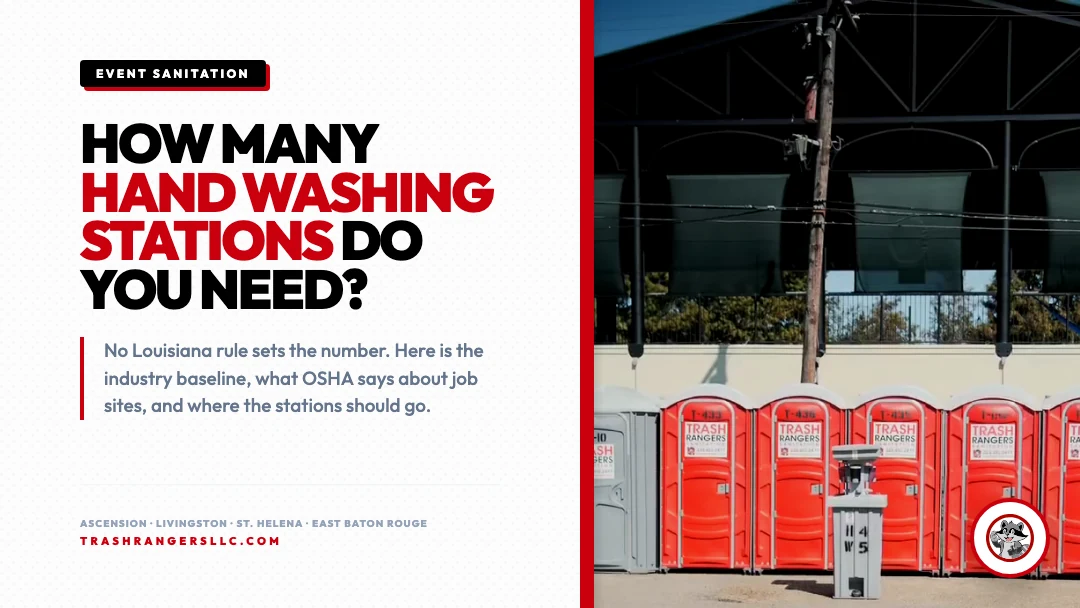
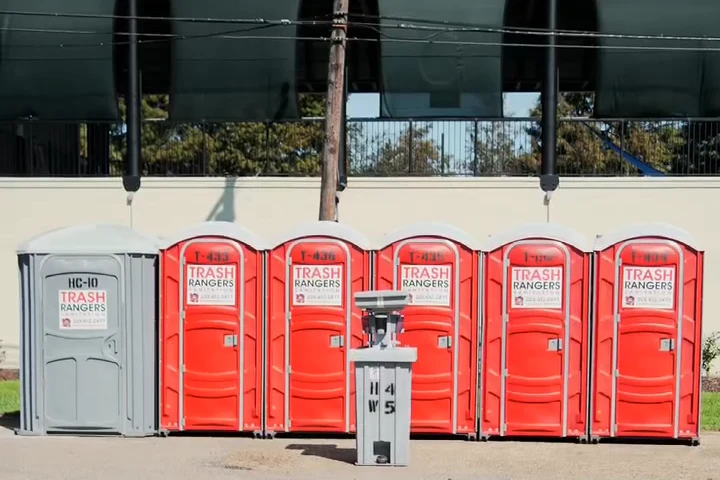
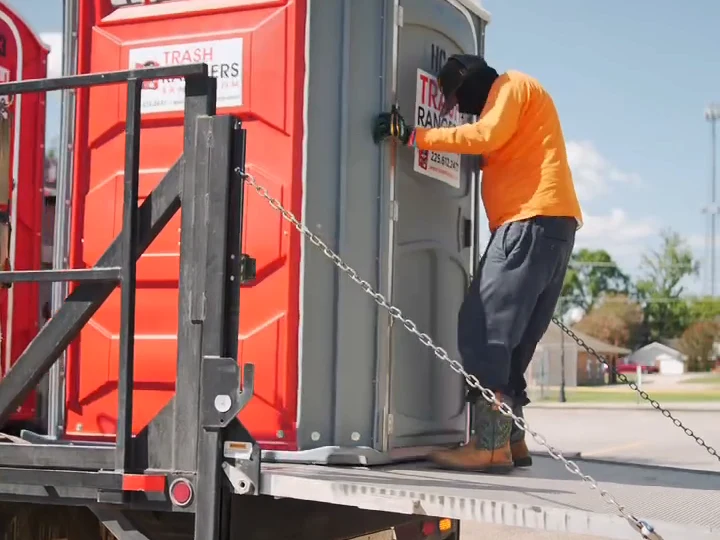
Our crew recently set up portable toilets and hand wash stations at Jambalaya Park in Gonzales. The last shot in the video above shows a row of six restroom units with a hand wash station set out in front of them. That one frame sums up a common planning question for event organizers and site supervisors: the restrooms are easy to count, so how many sinks go with them?
The honest answer starts with what the rules do and do not say, because most people assume there is a state number to hit. There is not.
Planning an event or a job site? Tell us the date, the location, and how many people you expect. We will size the restrooms and hand wash stations together and set them where people will actually use them.
What Louisiana’s Rules Actually Require
Louisiana writes its event sanitation rules in two places in the state sanitary code, and neither one sets a hand washing station count for the grounds.
The mass gathering rules in Part XXV cover “a group of 500 or more persons assembled together at any one time, for four or more hours” at a site other than a permanent place of assembly, under Section XXV-101. For those events, Section XXV-117 sets toilets “at the rate of 1 for each 200 persons or fractional part thereof.” That section is about toilets and urinals. It does not add a lavatory or hand washing requirement for attendees.
The temporary food service rules in Part XXIII are where hand washing shows up, and they land on each food operator rather than on the organizer. We covered those booth rules in detail in our festival vendor sanitation guide.
So an event can meet the written state toilet rule and still have no public place to wash hands. That gap is why organizers need a planning number that does not come from the state.
The Industry Baseline: One Station Per 10 Toilets
The portable sanitation industry publishes its own minimum standard, ANSI/PSAI Z4.3, through the Portable Sanitation Association International. The 2016 edition ties hand wash stations to the number of toilets, not to headcount. Section 6.3.1 says the number of units “is to be based upon the number of toilet facilities required,” and Table 2 sets the minimum.
Put simply, that is one hand wash station for every ten toilets, rounded up. Six units in a row, like the one in the video, lands in the first bracket: one station. Eleven units moves you to two.
Two caveats before you plan around it. First, PSAI has since issued newer editions, including a separate standard written for events open to the general public, and we have not been able to confirm that the table carried over unchanged. Treat the 2016 figure as a floor. Second, the same 2016 standard lets hand sanitizer inside each unit count as the hand cleansing method instead of a separate station. That is fine for a short, low-traffic setup. It is not the same thing as washing, which matters most around food.
Start From the Toilet Count
Because the industry number keys off toilets, size the restrooms first. For a mass gathering under the state rule, the math is simple: 1,000 people for four or more hours is 5 toilets at the 1 per 200 minimum, which points to 1 hand wash station.
Most events plan more restrooms than the state minimum, and they should. Event length, alcohol, and food service all push the count up, and we walk through that math in our guide to how many portable toilets you need for 200, 500, or 1,000 guests. Settle that number, then apply the one-per-ten baseline to it.
Then adjust for how your event actually runs:
- Food and drink service. Add a station at the food area, separate from the one by the restrooms. People eat with their hands at a crawfish boil or a festival, and they are not walking back to the restroom bank to wash first.
- Separate restroom banks. If the restrooms are split across the grounds, each bank needs its own station. A station on the far side of the field does not serve the second bank.
- Kids. Youth sports, school events, and family days get heavy hand washing traffic between games and meals.
- Messy work. Boil crews, cooking teams, and anyone handling raw seafood need soap and water, not a pump of sanitizer.
Food Vendors Bring Their Own
If your event has food trucks or booths, their hand washing is not covered by the stations you rent for the grounds. Louisiana puts it on each vendor. Under Section XXIII-4731, “When water under pressure is available, a hand washing facility shall be provided.” When it is not, “two buckets of water shall be provided for each food concessionaire,” one of potable water and one of sanitizing solution used as a hand dip well.
Worth telling vendors in your load-in packet, because many assume the organizer’s setup covers them.
Job Sites: What OSHA Actually Says
A lot of supervisors look for an OSHA ratio of hand wash stations per worker. There is not one in the construction rule. OSHA’s toilet table sets a count, but for washing facilities the obligation is written around the work being done.
The rule that applies on a typical temporary job site is 29 CFR 1926.51(f)(1):
The employer shall provide adequate washing facilities for employees engaged in the application of paints, coating, herbicides, or insecticides, or in other operations where contaminants may be harmful to the employees. Such facilities shall be in near proximity to the worksite and shall be so equipped as to enable employees to remove such substances.
The lavatory paragraphs that follow it are narrower than they read. In a 1994 interpretation, OSHA said paragraphs (f)(2) through (f)(4) “only apply to permanent places of employment.” So on a temporary site, the question is if your crew is handling something harmful. Paint, coatings, herbicides, and insecticides are named in the rule itself, and the last clause reaches any other contaminant that may be harmful.
When the rule applies, sanitizer and rags are usually not the answer. In a 2005 letter, OSHA wrote that “Typically, the employer’s provision of waterless hand cleaner and towels/rags would not be sufficient to remove” those contaminants, and that “The use of soap and water effectively reduces multiple hazards, while the use of soap-and-water substitutes could increase them.”
For comparison, the only OSHA rule with a per-worker hand washing count is the agriculture rule. 29 CFR 1928.110 requires “one handwashing facility” for “each twenty (20) employees or fraction thereof,” within a quarter-mile walk. It does not govern construction, but it is a useful reference point when you are planning for a large crew.
A practical setup for a crew is a station beside the restroom and, when there is painting or chemical work, a second one near the work zone. The goal in the rule is “near proximity to the worksite,” so a station at the far end of a large lot does not help the crew doing the work.
Why Soap and Water Beats Sanitizer
Sanitizer is useful, and it is not a replacement for a sink. The CDC’s hand sanitizer guidance says “Washing hands with soap and water is the best way to get rid of germs in most situations,” and that “Hand sanitizers may not be as effective when hands are visibly dirty or greasy.” When you do use sanitizer, CDC says to use one with at least 60% alcohol.
Think about the hands at your event. Boiled crawfish, barbecue, face paint, dirt from the ball field, or fresh paint on a job site: those are exactly the visibly dirty or greasy hands where sanitizer falls short. That is the case for a real hand wash station rental with water, soap, and paper towels.
Where to Put Hand Wash Stations
Placement is where a correct count still goes wrong. A few rules worth following:
- Beside the restrooms, not across from them. Food codes put handwashing “in, or immediately adjacent to, toilet rooms” for a reason. The FDA’s model Food Code uses that language. People wash when the sink is on their way out.
- At the food and drink area. A second station where people eat gets more use than a third one by the restrooms.
- On firm, level ground. A station that tips or sinks in soft ground after rain is out of service.
- Where the service truck can reach it. Stations need refilling and restocking on a multi-day event, so keep a clear path.
- Away from the main foot traffic lane. A line at the sink should not block the walkway.
Planning a Setup in the Baton Rouge Area
We place portable toilets and hand wash stations for events and job sites across Ascension, Livingston, and East Baton Rouge parishes. Tell us the date, the site, the expected crowd or crew size, and if food is being served, and we will size the restrooms and stations together. If your event also needs a permit, our event permit guide covers what the parishes ask for.
Hand Washing Station Questions
Common questions from event organizers and site supervisors.
Does Louisiana require hand washing stations at events?
Not for the grounds in general. The mass gathering rules set a toilet count of 1 per 200 people but do not add a hand washing requirement for attendees. Food vendors are different: each one must provide a hand washing facility, or two buckets when no pressurized water is available, under Section XXIII-4731 of the state sanitary code.
What is the standard ratio of hand wash stations to portable toilets?
The 2016 edition of the ANSI/PSAI Z4.3 industry standard sets one hand wash station for 1 to 10 toilets, two for 11 to 20, three for 21 to 30, four for 31 to 40, and one more for each additional 10. It is an industry minimum, not a state law, and newer editions exist.
Does OSHA require hand wash stations on construction sites?
OSHA requires adequate washing facilities near the work when employees apply paints, coatings, herbicides, or insecticides, or handle other harmful contaminants, under 29 CFR 1926.51(f)(1). The construction rule does not set a per-worker count. OSHA has said waterless hand cleaner and rags would typically not be enough to remove those contaminants.
Can hand sanitizer replace a hand wash station?
Sometimes, for light use. The 2016 industry standard allows sanitizer inside each unit as the hand cleansing method. But the CDC says soap and water is the best option in most situations and that sanitizer may not work as well on visibly dirty or greasy hands. Around food, messy work, or a job site with harmful materials, plan on real hand wash stations.
Where should hand wash stations go at an event?
Next to each restroom bank and at the food and drink area. Keep them on firm, level ground, out of the main walkway, and where a service truck can reach them for refills.
How many hand wash stations do I need for 500 people?
Start with the restroom count. At the state minimum of 1 toilet per 200 people, a 500-person event needs 3 toilets, which points to 1 hand wash station under the industry baseline. Most events plan more restrooms than the minimum, and food service adds a station at the food area, so many 500-person events end up with two or more.
Setting up for an event or a job site? Tell us the date, the location, and the headcount. We will size the restrooms and hand wash stations together and get them placed before your start time.