
Which Permits Does a Louisiana Event Need?
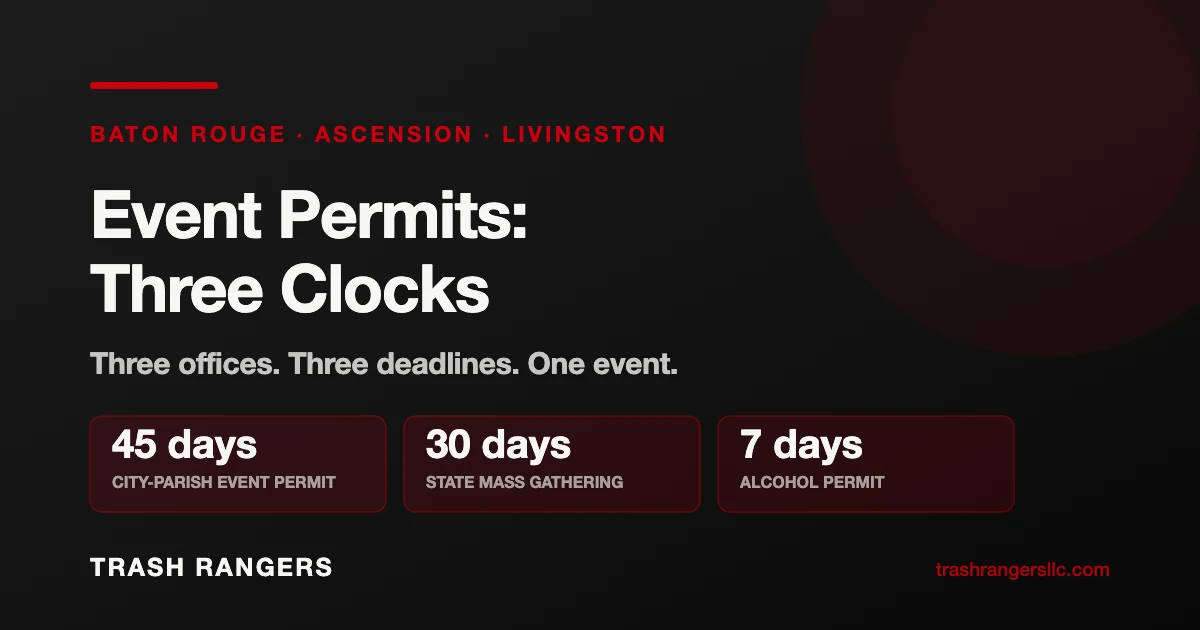
Most organizers need to think about three separate approvals, not one. The state mass gathering permit applies to any gathering of 500 or more people for four or more hours at a site that is not a permanent venue, and the application goes to your local health unit at least 30 days ahead. Food service at the event carries its own permits. And if the event is in East Baton Rouge, the City-Parish wants its own special event application at least 45 days ahead, with alcohol handled by a different office again on a much shorter clock.
TLDR:
- The state mass gathering permit is triggered at 500 or more people, for four or more hours, at a site other than a permanent place of assembly.
- Application goes to the local health unit at least 30 days in advance, and the permit must be in hand at least 72 hours before the start date.
- Water, sewage, and camping standards live inside that one permit. They are not separate applications.
- East Baton Rouge requires its own special event permit at least 45 days out, and suggests 60 days for parades, runs, and races.
- The EBR alcohol permit is a separate office with a 7-day deadline, council member approval, and one security officer per 100 patrons.
- The state food permit fee for a temporary or special event is twenty-five dollars for the entire event, and churches, nonprofits, and government facilities are exempt.
- Recognized fairs and festivals can be exempt from retail food permits, but the recognition has to be in writing.
- East Baton Rouge and Ascension sit in one state health region. Livingston sits in a different one.
The question organizers ask us is “do I need a permit,” and the honest answer is that the question has at least three answers, because at least three different offices may have a say. They do not share a deadline, an application, or a phone number.
Here is how the layers actually stack in East Baton Rouge, Ascension, and Livingston Parishes.
Sorting out an event site? Tell us the guest count, the dates, and the location. We will handle the restroom and waste side and tell you what the state expects on the ground.
Layer One: The State Mass Gathering Permit
This is the one most organizers have never heard of, and it is the one with real teeth.
Section XXV-101 of the Louisiana sanitary code defines a mass gathering as “a group of 500 or more persons assembled together at any one time, for four or more hours, for a meeting, festival, fair, social gathering, or other similar purposes at a site other than a permanent place of assembly.”
Read that as a three-part test, because all three parts have to be true. Five hundred or more people, at one time. Four or more hours. And a site that is not a permanent venue. A 450-person festival is outside it. A 2,000-person event in an established arena is outside it, because the arena is a permanent place of assembly. A 600-person crawfish boil in a field for six hours is squarely inside it.
The deadlines are two different numbers
Section XXV-103 sets both:
Application for Permit-written application for permit must be received by the local health unit at least 30 days in advance of the proposed mass gathering.
The operator shall meet all provisions of the state sanitary code and obtain the necessary permit at least 72 hours prior to the starting date of the mass gathering.
Thirty days to apply, and the permit in hand no later than 72 hours before gates open. Missing the second one is how events get held up at the last minute even though the paperwork went in on time.
What has to go with the application
Section XXV-103 also lists what accompanies it, and the list is more demanding than most organizers expect:
an outline map of the area to be used showing the location of all proposed toilets to be used, lavatory and bathing facilities, water supply sources, areas of assemblage, camping areas, food service areas, emergency egress roads, refuse disposal, and collection facilities. Also included must be detailed drawing of toilet facilities, sewage disposal system, lavatory and bathing facilities, and water supply system. An anticipated attendance figure shall also be included.
In practice that means your restroom and waste plan is part of the permit application, not something you sort out afterward. If you are working out counts, our guide to portable toilet numbers by guest count covers the math, and when you book portable toilet rentals with us, we can give you placement for the site map.
The duties land on the operator
Section XXV-103 is explicit about who is responsible:
The operator shall be responsible for meeting the provisions of these standards and regulations to serve the maximum number of people to be assembled, for operational maintenance, and for the clean, safe, and sanitary condition of the grounds, sanitary facilities, and other service equipment.
That is you, not your vendors. Your food vendors carry their own separate duties at their own booths, which we cover in festival vendor sanitation, but the grounds are the operator’s problem.
What Is Not a Separate Permit
Worth saying plainly, because it saves phone calls: water, sewage, and camping facilities do not carry their own event applications. They are standards folded into the single mass gathering permit.
Section XXV-115 requires potable water under pressure at not less than 20 psi meeting the requirements of Part XII of the sanitary code, and sets quantities of 5 gallons per person per day for drinking and washing, rising to 15 gallons per person per day where toilets and showers are provided. Section XXV-305 requires connection to a public sewer where one is available, and a private disposal facility meeting Part XIII where one is not. Section XXV-303 adds showers at not less than one per 250 persons when attendees are expected to remain for 48 hours or longer, which is the provision that catches multi-day camping events.
Those are requirements you meet on site. They are not forms you file.
Layer Two: Food Permits and the Exemption That Confuses Everyone
If food is served or sold, permits enter through a different door. The individual booth permit falls on each vendor rather than on you, and the details are in our festival vendor guide.
Two things here are the organizer’s business.
The fee is per event, not per booth. Louisiana R.S. 40:31.37 subsection F: “For temporary or special events, including fairs and festivals, requiring a food establishment permit, the department shall charge a twenty-five dollar fee for the entire event.” Subsection H exempts state and local government facilities, churches, and nonprofit organizations as defined by the IRS.
The exemption has to be in writing. The Louisiana Department of Health’s own guidance for temporary events puts it this way: “Fairs or festivals that are officially acknowledged in writing as recognized by a state, parish or municipal governmental body or by the Louisiana Association of Fairs and Festivals are exempted from requiring retail food permits.”
That written acknowledgment is the part people skip. Being a long-running local festival is not the same as being recognized in writing by a governmental body or by the Louisiana Association of Fairs and Festivals. If your event relies on that exemption, get the acknowledgment on paper and keep a copy on site.
The same LDH guidance notes a narrower allowance for a religious or charitable organization’s bake sale, where the consumer is informed by a clearly visible placard that the food was prepared in a kitchen not subject to regulation and inspection.
Who You Actually Call: The Parish Health Units
The sanitary code says applications go to “the local health unit.” For this service area, that is one of three offices, and the regional split surprises people.
East Baton Rouge and Ascension are both in the Louisiana Office of Public Health Region 2, the Baton Rouge area office, at 353 N. 12th St., Baton Rouge, LA 70802, 225-242-4860. Livingston is not. Livingston sits in Region 9, the Tangipahoa area office, at 15481 W. Club Deluxe Road, Hammond, LA 70403, 985-543-4880.
The parish health units themselves:
| Parish | Health unit | Address | Phone |
|---|---|---|---|
| East Baton Rouge | East Baton Rouge Parish Health Unit | 353 N. 12th Street, Baton Rouge, LA 70802 | 225.242.4860 |
| Ascension | Ascension Parish (Gonzales) Health Unit | 1024 S.E. Ascension Complex, Gonzales, LA 70737 | 225.474.2004 |
| Livingston | Livingston Parish Health Unit | 20399 Government Blvd., Livingston, LA 70754 | 225.686.7017 |
If your event crosses a parish line, or you are choosing between sites in different parishes, that regional split is worth knowing before you start the conversation.
Layer Three: The Local Permit, Which Varies a Lot
This is where the three parishes stop looking alike.
East Baton Rouge
East Baton Rouge runs the most developed special event process of the three, and it is the one with the most requirements to plan around. From the City-Parish special events page: “Prior to hosting a special event, a permit must be issued. Permit Applications must be received a minimum of 45 days prior to the event date.” For parades and races, “It is suggested that applications be submitted no later than 60 days prior to the event.”
Other requirements that come with it:
- Events on City-Parish property require “a Certificate of Liability Insurance naming the City-Parish as an Additional Insured.”
- Street or sidewalk closures need a street closure permit with approval from both the Baton Rouge Police Department and Traffic Engineering, and “Street closures will require additional officers.”
- “All special events must be approved by the Baton Rouge Police Department,” with staffing costs estimated during the application.
- Vendor locations must be shown on the event plan, and vendors may need a City-Parish and LDR occupational license.
- Downtown events are coordinated through the Downtown Development District, 225-389-5520.
And one that matters directly for anyone renting containers: “All special events must cover litter and cleanup costs provided by the City-Parish.” A preliminary estimate comes with the application, with the final subject to review by DPW. Organizers who arrange their own waste service and site cleanup have a clearer handle on that line than organizers who leave it to be estimated.
Alcohol is its own permit, on its own clock
If alcohol is served in East Baton Rouge, the City-Parish Office of Alcoholic Beverage Control issues a separate temporary special event permit from 9048 Airline Hwy., Baton Rouge, LA 70815, (225) 389-3364. Its requirements read very differently from the 45-day event permit:
- “A completed special event application form, (7) days prior to the event.”
- The permit “may be issued by the Alcoholic Beverages Control Office with the approval of the council member in whose district the special event is to be held.”
- Licensed security, “P.O.S.T. certified law enforcement officers and/or security personnel who have completed the Louisiana ATC security personnel training course as required by LA R.S. Title 26:934(2), 1 per every 100 patrons.”
- “Special event area must be fenced off from the general public. A rope or cord is not acceptable.”
- “No more than (12) Special Event Permits shall be issued to any location in any given year.”
- Permits run one to three consecutive days.
- “Fee: Special Event Permit for Beer only is $120.00 and Wine, Beer and Liquor is $360.00”
A state permit from the Louisiana Office of Alcohol and Tobacco Control may also be required. Under LAC Title 55, Section VII-323, temporary retail alcohol permits run a maximum of three consecutive days, come in three types, and are capped at 12 per person or organization per year. Type A goes to tax-exempt organizations with no fee, Type B carries a $10 handling fee, and Type C carries a $100 fee.
Note the clash worth planning around: the event permit wants 45 days, the local alcohol permit wants 7. Working backward from the longest deadline is the only way both land.
Ascension Parish
Ascension Parish publishes its permit applications online, and the list is construction focused. Building, electrical, mechanical, plumbing, occupancy, signs, fences, pools, mobile homes, and a peddler license. No special event or festival permit appears among them.
Be careful how you read that. It means the parish does not publish one in its permitting list, not that your event needs no local approval. Municipal events inside Gonzales, Donaldsonville, or Sorrento go through the city rather than the parish, and a specific venue may have its own requirements. Call the parish before assuming.
In Gonzales, the city lists a special event permit among its permit types, and notes that licensed food trucks may operate under special event permits granted by the Gonzales City Council. The permit office is at 120 South Irma Blvd., 225.647.9559.
Livingston Parish
Livingston Parish’s published permit inventory is also construction focused: building permits, contractor applications, occupancy, and flood zone determinations. No special event permit appears in it either.
Same caution applies, and a little more strongly, since we could not retrieve a full listing of parish forms. The parish government office is at 20399 Government Blvd., Livingston, LA 70754, 225-686-2266. Ask them directly rather than assuming the absence of a published form means no approval is needed.
Building the Timeline Backward
Working from the tightest real deadline to the loosest, for an East Baton Rouge event with food and alcohol:
| When | What | Who |
|---|---|---|
| 60 days out | Parade, run, or race application suggested | EBR City-Parish |
| 45 days out | Special event permit application due | EBR City-Parish |
| 30 days out | Mass gathering application due | Parish health unit |
| 7 days out | Local alcohol permit application due | City-Parish ABC |
| 72 hours out | Mass gathering permit must be in hand | Parish health unit |
Two of those are application deadlines for the same event from two different agencies, which is why organizers who treat permitting as one task tend to miss one.
Event Permit Questions
What organizers ask us most while they are putting an event together.
Does my event need a Louisiana mass gathering permit?
Only if all three conditions are met: 500 or more people assembled at one time, four or more hours, and a site that is not a permanent place of assembly. An event that misses any one of the three falls outside the definition in Section XXV-101.
How far ahead do I apply for the state permit?
The written application must be received by the local health unit at least 30 days in advance, and the permit itself has to be obtained at least 72 hours before the start date. Those are two separate requirements in Section XXV-103.
Do I need a separate permit for water and sewage at my event?
No. Water supply, sewage disposal, and shower requirements are standards inside the mass gathering permit rather than separate applications. You meet them on site, and the site plan you file with the application is where you show how.
How much is the state food permit for a festival?
Twenty-five dollars for the entire event under R.S. 40:31.37(F), for temporary or special events including fairs and festivals that require a food establishment permit. State and local government facilities, churches, and nonprofit organizations are exempt from the fee.
Is my festival exempt from food permits?
Possibly, but the exemption depends on paperwork. LDH’s guidance states that fairs or festivals officially acknowledged in writing as recognized by a state, parish, or municipal governmental body, or by the Louisiana Association of Fairs and Festivals, are exempt from requiring retail food permits. Get that acknowledgment in writing and keep a copy.
Who issues event permits in Ascension and Livingston Parish?
Neither parish publishes a special event permit among its permit applications, both of which are construction focused. That does not mean no approval is needed. Municipal events go through the city, and you should call the parish directly. Gonzales does list a special event permit, granted by the City Council.
How long before an event do I need the alcohol permit in Baton Rouge?
The City-Parish Alcoholic Beverage Control office asks for a completed application seven days prior, with approval from the council member for the district. A state permit from the Office of Alcohol and Tobacco Control may also be required, and those run a maximum of three consecutive days.
Who is responsible for restrooms and cleanup at the event?
The operator. Section XXV-103 puts responsibility for the clean, safe, and sanitary condition of the grounds and sanitary facilities on the operator of the gathering. Individual food vendors carry separate duties at their own booths, but the grounds are yours.
Got the permits started and need the site handled? Give us the guest count, the dates, and the location, and we will put together the restroom and waste plan, including the placement detail your permit application asks for.