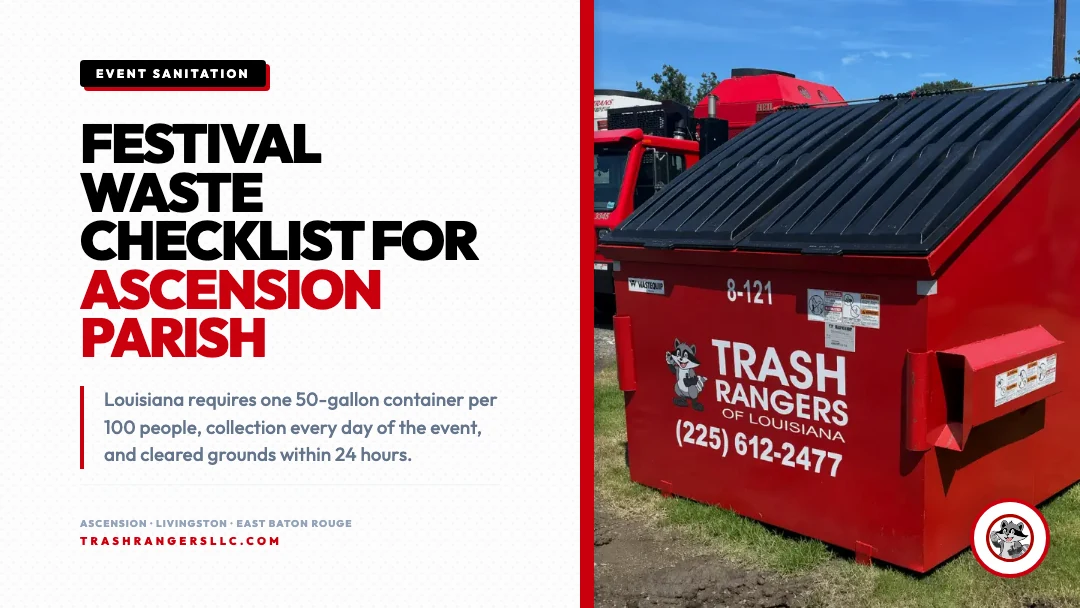

Planning Trash and Dumpster Service for an Ascension Parish Festival
Louisiana sets a real trash standard for events at 500 or more people. You need one 50-gallon container for every 100 people anticipated, refuse collected at least once each day, and the grounds cleared within 24 hours of the last guest leaving. Meeting that takes distributed waste stations plus a dumpster behind them, not one or the other.
TLDR:
- Louisiana’s mass gathering standard applies at 500 or more people assembled four hours or longer at a site that is not a permanent venue.
- The refuse rule is one 50-gallon container per 100 people anticipated, and those containers have to be readily accessible.
- A dumpster by itself does not satisfy the rule, because the code asks for accessible containers spread across the site.
- Collection is required at least once each day of the event, so a multi-day festival requires a servicing schedule booked in advance.
- The grounds and immediate surrounding properties have to be cleared within 24 hours after the event ends.
- Food vendors change the math more than attendance does, because of cardboard, packaging, and ice.
- Size the dumpster behind your stations, then book teardown haul-off at the same time you book delivery.
Ascension Parish runs on outdoor events. Lamar-Dixon fills up for festivals and expos, church grounds in Gonzales and Prairieville host fall fairs, and Donaldsonville puts people on the street for music and markets. Organizers plan the stage, the vendors, and the restrooms. The trash plan tends to get made in the parking lot at 6 a.m. on event day, and the cleanup bill gets made the Monday after.
Have an event date on the calendar? Tell us the site, the headcount you are expecting, and how many days you are running. We will size the containers and the dumpster behind them and tell you what the property actually needs.
What Louisiana Actually Requires at a Mass Gathering
Most organizers have never read this section, and it is short enough to read in a minute. It matters because it turns trash from a judgment call into a number you can plan against.
Louisiana defines a mass gathering as a group of 500 or more persons assembled at any one time for four or more hours at a site other than a permanent place of assembly. A festival on a field, a fairground, or a closed street is squarely inside that definition. A concert in an established venue with its own facilities is not.
Once you are inside it, the state’s refuse standard for mass gatherings asks for four things: one 50-gallon container or equivalent for every 100 people anticipated, containers that are readily accessible, collection from the assembly area at least once each day of the event, and disposal at a site approved by the state health officer.
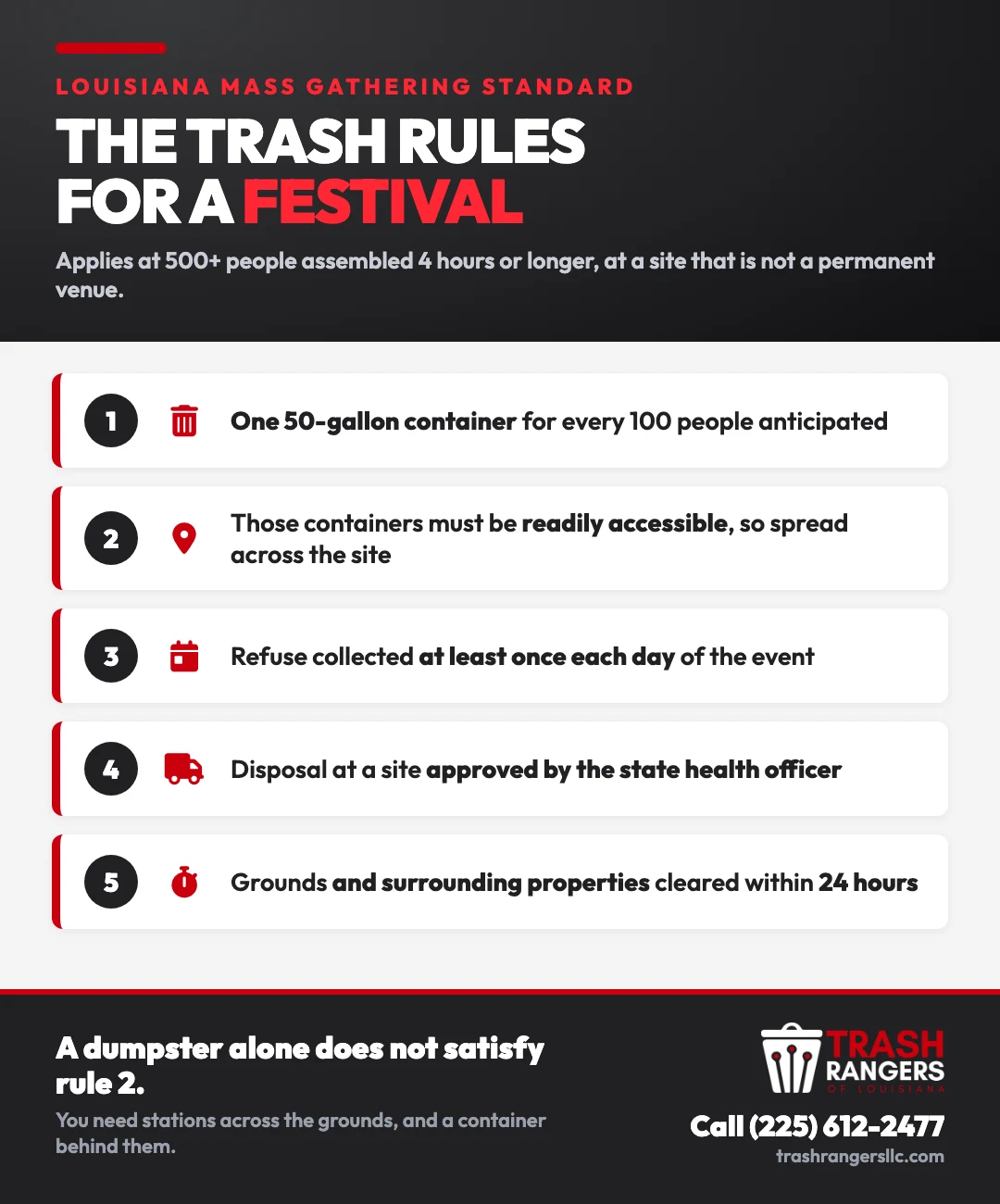
There is a fifth requirement that catches people. The grounds and the immediate surrounding properties have to be cleaned of refuse within 24 hours after the gathering ends. That deadline is the one that turns into a problem, and we come back to it below.
If your event stays under 500 people or runs under four hours, none of this is binding on you. It is still the most sensible sizing framework available, so use it as a planning floor rather than ignoring it.
Why the Container Rule Is Not a Dumpster Rule
This is the single most common misread, and it costs organizers money in the wrong direction. They book one large dumpster, feel covered, and still end up with litter across the site.
Read the wording again: containers that are readily accessible. That is describing receptacles distributed where people actually are, near food, near seating, near exits. A 30-yard roll-off parked behind the vendor row has enormous capacity and is readily accessible to almost nobody.
The practical structure is two layers. Layer one is the attendee-facing waste stations across the grounds, which is what the per-100 ratio is really counting. Layer two is the container those stations get emptied into over the course of the day, which is what keeps the stations from overflowing by mid-afternoon.
Plan both. A site with good station coverage and no dumpster runs out of room. A site with a big dumpster and thin station coverage produces a field of cups.
Sizing the Dumpster Behind Your Stations
Once the stations are set, the question becomes what they get emptied into. Converting the state’s container math into dumpster capacity gives you a starting point you can sanity-check.
A 50-gallon container is roughly a quarter of a cubic yard, so the code minimum translates to about a quarter yard of capacity per 100 people anticipated. Against the sizes we run in Ascension Parish, that works out like this:
| Container | Rough capacity in 50-gallon units | Code-minimum equivalent |
|---|---|---|
| 2-yard front-load | about 8 | 800 people |
| 4-yard front-load | about 16 | 1,600 people |
| 6-yard front-load | about 24 | 2,400 people |
| 8-yard front-load | about 32 | 3,200 people |
| 15-yard roll-off | about 60 | 6,000 people |
| 20-yard roll-off | about 80 | 8,000 people |
| 30-yard roll-off | about 121 | 12,100 people |
Read that table as a floor and not a forecast. The code sets minimum container capacity made available to attendees, which is a different thing from the total volume your event will actually generate, and back-of-house vendor waste sits entirely outside it.
For a deeper walk through how these sizes behave in practice, our guide to choosing between 15, 20, and 30-yard roll-offs covers the tradeoffs in load height and footprint that matter on a tight event site.
Not sure which size fits your grounds? Send us the site layout and the gate access. A 30-yard needs room for the truck to tilt and pull, and some festival sites simply cannot take one.
Where Waste Stations Go on a Festival Site
Placement decides if your containers get used or bypassed. People carry trash about as far as they are willing to, and no farther.
Pair every station with a recycling companion if you are separating streams, because a lone bin gets treated as general trash regardless of the label. Put stations at the exit from every food area, at the entry and exit gates, and along the seating perimeter rather than in the middle of it.
Keep them off the grass where the truck or cart has to reach them, and keep them out of the path the fire lane needs. A station that blocks emergency access gets moved on event day by someone who is not thinking about your waste plan.
The same site-plan logic applies to the restroom side of your event. Our Baton Rouge event organizer’s guide to ADA restroom placement covers the accessibility rules that govern where those units can legally sit, and the two plans should be drawn on the same map.
Food Vendors Change the Math More Than Attendance Does
A festival with ten food vendors generates a different waste profile than a festival with the same headcount and two. This is where most sizing estimates go wrong.
Vendor waste is bulky before it is heavy. Cardboard cases, packaging film, produce crates, and ice bags fill volume fast, and it all arrives during load-in and load-out rather than spread across the day. Cooking oil and grease are a separate disposal stream and should never go into a general container.
Set vendor rules in writing when you send the vendor packet, not on event morning. Require cardboard to be broken down, name the container vendors are allowed to use, and say plainly what is not accepted.
If your event is vendor-heavy, our commercial dumpster sizing guide for the Baton Rouge area shows how food service volume behaves against container size, and the same pattern holds on a festival site.
Multi-Day Festivals and the Daily Collection Rule
A two-day or three-day event is not a one-day event with more people. The code treats it differently, and so should your booking.
Collection is required at least once each day of the assembly. That means a service visit scheduled between operating days, not a single haul-off at the end. Book that cadence when you book the container, because a same-day service call during festival weekend is the hardest thing to arrange.
Overnight is the other consideration. Containers sitting full on an open site draw animals and produce exactly the odor and nuisance conditions the code tells you to prevent. Lidded containers and an end-of-night station sweep handle most of it.
Confirm your servicing window against the site’s access hours. If the gates lock at 11 p.m. and open at 7 a.m., the truck needs to fit inside that.
The 24-Hour Teardown Clock
This is the requirement that turns into an actual problem, and it is the one organizers plan for last. The grounds and the immediate surrounding properties have to be clear of refuse within 24 hours of the event ending.
Note the wording: the immediate surrounding properties. That reaches past your fence line, to the neighboring lot and the street where your attendees parked and walked. Litter that blew two properties over is still inside the standard.
The practical answer is to book the final haul-off at the same moment you book the delivery. Then schedule a perimeter litter sweep as a named crew assignment, not as something volunteers do if there is time. Teardown produces its own surge, because everything that was a display at 4 p.m. is waste at 8 p.m.
Give yourself container capacity that is still available after the event closes. A container that filled on Saturday afternoon leaves you nowhere to put Sunday night.
What Ascension Parish Organizers Ask About Festival Waste
These come up most often when we scope an event in Gonzales, Prairieville, Donaldsonville, and the surrounding communities. If your situation is not here, call us, and we will work through it against your site.
How many trash containers does a 2,000-person festival need in Louisiana?
At the state’s mass gathering standard of one 50-gallon container per 100 people anticipated, a 2,000-person event calls for about 20 containers of that size distributed across the grounds. That is a minimum floor for accessible receptacles, and it does not account for vendor waste, which is usually handled in a separate dumpster.
Does a dumpster satisfy Louisiana’s mass gathering refuse requirement?
Not on its own. The code asks for containers that are readily accessible to the people at the assembly, which means receptacles spread across the site where attendees are. A dumpster is where those get emptied. Most events require both layers, and planning only one is the most common gap we see.
Do I need a permit for festival dumpster service in Ascension Parish?
Container delivery itself is a service arrangement rather than a permit item, but your event may need parish or municipal approvals covering the gathering as a whole. Requirements differ between Gonzales, Donaldsonville, and unincorporated Ascension Parish, so confirm with the permitting office for your specific site.
How far in advance should I book event dumpster service?
Book as soon as your date and site are locked, especially during the fall and spring event seasons when Ascension Parish weekends fill up. Booking early also gives you time to solve access problems, and a site that cannot physically take a roll-off is much easier to work around six weeks out than six days out.
What do I do with cooking oil and grease from food vendors?
Keep it entirely out of your general waste containers. Cooking oil is a separate disposal stream, and grease poured into a dumpster leaks, contaminates the load, and creates exactly the nuisance conditions the state code tells organizers to prevent. Require vendors to handle it in their own sealed containers and name that rule in your vendor packet.
Does the 24-hour cleanup rule include the parking areas?
The standard covers the grounds and the immediate surrounding properties, which reaches beyond the event footprint itself. Parking areas, the approach route, and neighboring lots where attendee litter lands are all realistically inside it. Plan a perimeter sweep as an assigned crew task rather than leaving it to whoever is still on site.
Can Trash Rangers service containers during a multi-day event?
Yes. Multi-day events need collection at least once each day under the state standard, and we schedule those service visits between operating days. Tell us your gate access hours when you book, because the servicing window has to fit inside the times a truck can actually reach the container.
Let’s get the waste side of your site plan finished. Give us the location, your expected attendance, the number of days, and your food vendor count. We will come back with a container plan, a servicing schedule, and a teardown haul-off that clears the grounds inside the 24-hour window. No surprises on the invoice, and no scramble on the Monday after.
Trash Rangers runs residential, commercial, and event service across Ascension, Livingston, and East Baton Rouge Parishes. You can check coverage for your site on our service areas map, or reach the team directly with the details of your event.