
Shared Dumpster Service for Apartment Communities and Retail Strips
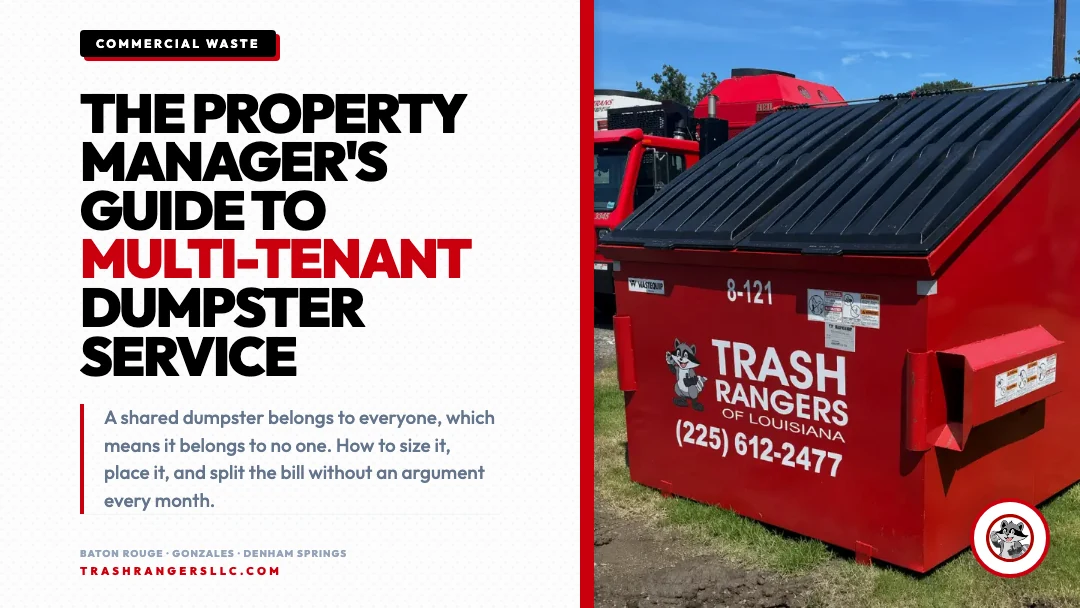
Multi-tenant waste fails for a structural reason, not a service one: the container is shared, so no single tenant owns the outcome. Getting it right comes down to four decisions. Size for your busiest week rather than your average one, confirm the truck can physically reach the enclosure, decide up front who absorbs contamination and overflow charges, and revisit the whole arrangement whenever your tenant mix changes.
TLDR:
- A shared dumpster has no owner, which is why it behaves differently from a single-business container.
- Size for the worst week of the month, not the average week. Averages hide the problem.
- More frequent pickups often beat a larger container when the enclosure is tight.
- Truck access decides more than capacity does. If the driver cannot reach it, size is irrelevant.
- Contamination and overflow charges need an owner in writing before they appear on an invoice.
- Apartment move-out season and retail tenant turnover are predictable spikes you can plan around.
- Revisit the service level whenever the tenant mix changes, not at renewal.
Drive any apartment community off Airline Highway or a retail strip in Gonzales on a Sunday evening, and you can spot the trouble from the parking lot. The enclosure gate is propped open, there is a couch beside the container, and cardboard is stacked against the wall because the box is already full. Monday’s pickup will handle the container. It will not handle the couch or the cardboard, and the property manager is the one who hears about all three.
Managing a property where the dumpster is a recurring headache? Tell us the property type, the number of units or tenants, and where the enclosure sits. We will tell you what the property actually needs and confirm our truck can service it.
Why Multi-Tenant Waste Behaves Differently
A single business owns its dumpster problem. If a restaurant fills its container early, the manager notices, because it is their kitchen and their back door.
A shared container has no such feedback loop. The tenant who overfills it on Thursday is not the tenant who finds it full on Friday, and neither of them is the person paying the invoice.
That is the whole difficulty in one sentence. Every practical decision below is really an attempt to design around it.
Size for the Worst Week, Not the Average One
Most multi-tenant properties are sized on a monthly average, which is the number most likely to mislead you.
Waste at an apartment community is not evenly distributed across the month. It spikes at the end and the start, when leases turn over. A retail strip spikes when a tenant takes a delivery, runs a promotion, or does a seasonal reset.
If your container is sized for a normal week, it will fail during every one of those. What you notice is overflow. What is actually happening is that the container was correct on paper and wrong in practice.
A useful test: think about the last three times the enclosure overflowed. If you can name the cause each time, you do not have a capacity problem, you have a peak problem. Those are solved differently.
Frequency Often Beats Capacity
The instinct when a container overflows is to ask for a bigger one. That is sometimes right and often not.
A larger box needs more room to sit, more clearance to service, and more space for the truck to work. Plenty of enclosures in older Baton Rouge properties were poured for a container size that has since been outgrown, and the walls do not move.
Adding a pickup day is frequently the better answer. It costs less than rebuilding an enclosure, it smooths the peaks instead of just absorbing them, and it can be scaled back later if the tenant mix changes.
If you want the sizing logic itself, we broke it down in our guide to commercial dumpster sizes and in the comparison of 15, 20, and 30-yard containers.
Access Decides More Than Capacity Does
This is the part that gets skipped, and it is the part that ends service agreements.
A front-load truck needs room to approach the container square, lift it overhead, and set it back down. That means vertical clearance with nothing above it, a straight approach, and enough turning room to leave without reversing across the lot.
Common problems at Baton Rouge area properties are consistent enough to list. Low tree limbs over the enclosure. A gate that swings inward and blocks the approach. Cars parked in the service lane because nobody marked it. A carport or covered walkway added after the enclosure was built. Soft ground beside the pad that a loaded truck will sink into after a wet week.
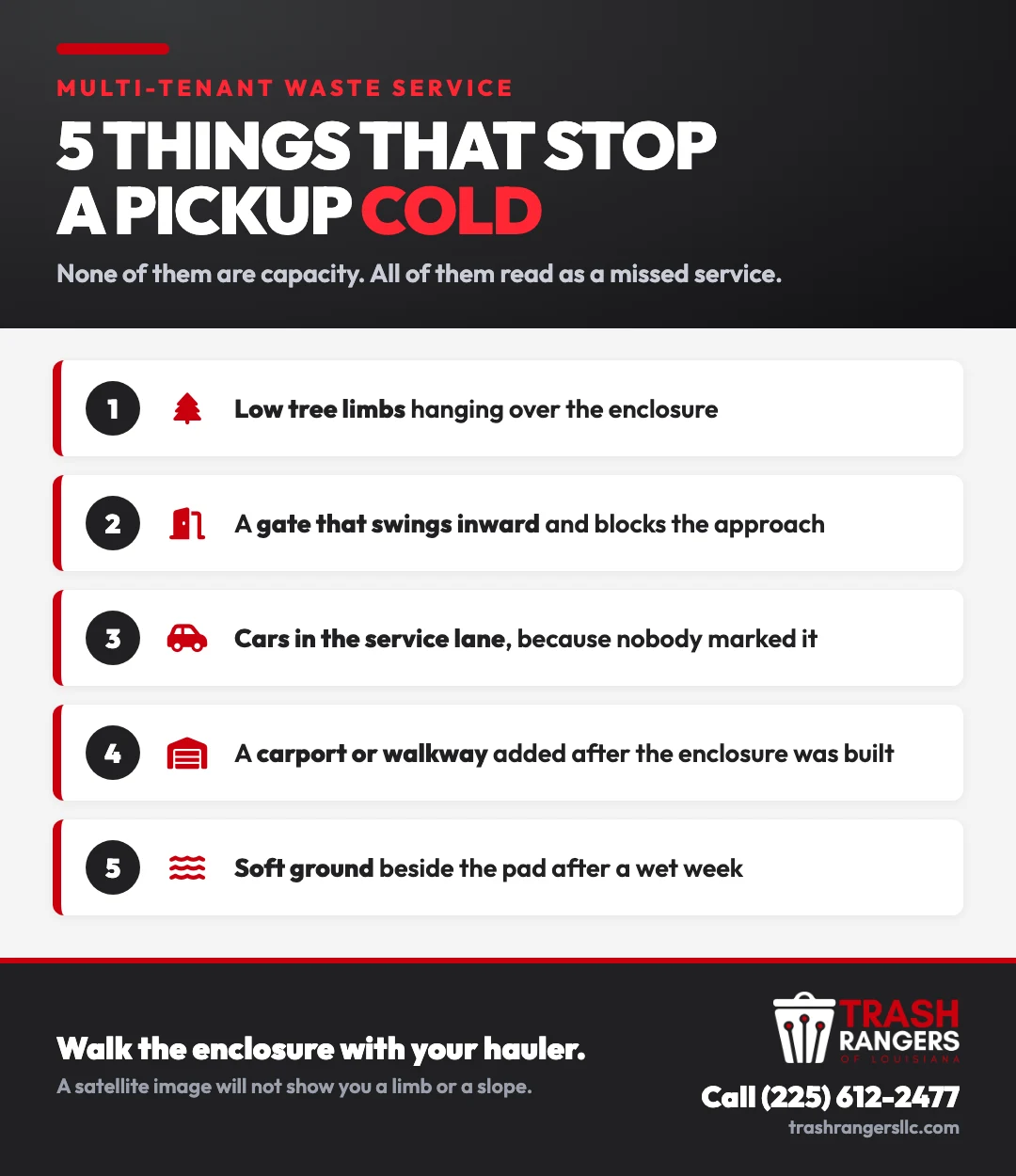
None of these are capacity issues. All of them will stop a pickup, and the tenants will experience it as a missed service.
Before you sign anything, have the hauler look at the enclosure in person. A satellite image will not show you a limb or a slope.
Contamination and Overflow Need an Owner
Two charges show up on multi-tenant invoices more than any others, and both are avoidable with a decision made early.
Contamination is the wrong material in the container. At a retail strip this is usually construction debris from a tenant build-out, or liquid waste from a food tenant. At an apartment community it is paint, tires, appliances, and electronics. Tires carry their own rule: under Louisiana law, La. R.S. 30:2418, waste tires that have not been processed or recycled may not be knowingly deposited in a landfill.
Overflow is material that will not fit, which usually means it ends up beside the container rather than in it. A driver empties the box. They are not obligated to pick up what is stacked around it.
The question worth settling before it happens is simple: when either charge appears, who absorbs it? The property, the responsible tenant, or the common area budget? If the answer is not in the lease or the service agreement, it becomes an argument every time.
Move-Out Season Is Predictable, So Plan For It
At an apartment community, the heaviest waste weeks of the year are not a surprise. They follow the lease calendar.
Furniture, mattresses, and general household bulk appear in volume at turnover. None of it belongs in a front-load container, and most of it will not fit anyway.
The workable approach is to schedule a temporary roll-off for the turnover window rather than trying to force the volume through the regular container. It keeps the enclosure usable for everyday trash, and it puts the bulky material somewhere it can actually go. Our bulk trash removal service exists for exactly this pattern.
Retail has its own version. A tenant vacating a space generates fixtures, shelving, and signage in a single week, and a build-out for the incoming tenant generates more.
Retail Strips Have a Cardboard Problem
Cardboard is the single biggest volume driver at most retail centers, and it is the material most likely to be handled badly.
An unbroken box takes up several times the space of a flat one. A container that would comfortably hold a week of flattened cardboard will fill in two days if nobody breaks anything down.
This is worth a conversation with tenants rather than a bigger container. Flattening costs nothing and can meaningfully change what service level the property needs.
Food tenants add a second issue. Grease, liquid, and wet organic waste raise weight, attract pests, and create odor complaints that reach you rather than the tenant who caused them.
Allocating the Cost Without an Argument
In most retail leases waste is a common area expense, which means it is allocated by square footage. That is administratively simple and often unfair.
A 1,200 square foot restaurant will generate several times the waste of a 1,200 square foot insurance office. Under a straight square footage split, the office subsidizes the restaurant, and eventually the office notices.
There is no universally correct answer here, but there are workable ones. Some properties allocate by square footage with a surcharge for food service tenants. Others bill heavy generators separately. A third approach gives a high volume tenant its own container, so the shared box serves everyone else.
What matters is that the method is written down and explainable. Most disputes are not really about the amount, they are about the tenant not understanding how the number was reached.
What to Ask Before You Sign
A short list that saves trouble later.
- What size and how many pickups, and what happens when the property outgrows it?
- Has someone physically looked at the enclosure and confirmed truck access?
- What triggers a contamination or overflow charge, and how are they documented?
- Can service scale up temporarily for move-out season or a tenant build-out?
- Who do I call when a pickup is missed, and how fast is the recovery?
- Is there a fuel, environmental, or administrative surcharge, and is it capped?
The last one matters more than property managers expect. A quoted rate that moves every quarter is not really a quoted rate.
Questions Baton Rouge Property Managers Ask
Short answers to the things that come up most often when we walk a property.
How do I know if my dumpster is the wrong size?
Look at the week before pickup rather than the day after. If the container is consistently full more than a day early, or material is regularly stacked beside it, the service level is short. If it is half empty at pickup most weeks, you are paying for capacity you do not use.
Is it better to get a bigger dumpster or more frequent pickups?
It depends on the enclosure. If there is room for a larger container and clearance to service it, upsizing is usually cheaper per yard. If the enclosure is already tight, which is common at older properties, adding a pickup day is the more practical fix.
Who is responsible when a tenant dumps something they should not?
Whoever the lease and service agreement say, which is why it needs to be decided before it happens. If nothing is written down, the charge lands on the property, and you are left trying to recover it from a tenant who will deny it.
Can we get a separate dumpster for one heavy tenant?
Often yes, and at retail centers with a restaurant it is frequently the cleanest solution. It removes the biggest generator from the shared container and makes the remaining allocation much easier to defend.
What do we do about furniture at an apartment community?
Schedule for it rather than react to it. Turnover volume is predictable, and a temporary roll-off during the window handles what a front-load container cannot. Leaving bulk items beside the enclosure invites more of the same.
Do you service properties outside Baton Rouge?
Yes. We run multi-tenant service across the greater Baton Rouge area, including East Baton Rouge, Ascension, and Livingston Parishes, so communities in Gonzales, Prairieville, Denham Springs, and Walker are all inside the footprint. The service areas page has the current coverage map, and if your property sits on the edge of it, call and we will tell you straight.
Want a straight answer on what your property needs? Send us the property type, unit or tenant count, and a photo of the enclosure. We will tell you the right size, the right frequency, and a straight answer on truck access before anyone signs anything.