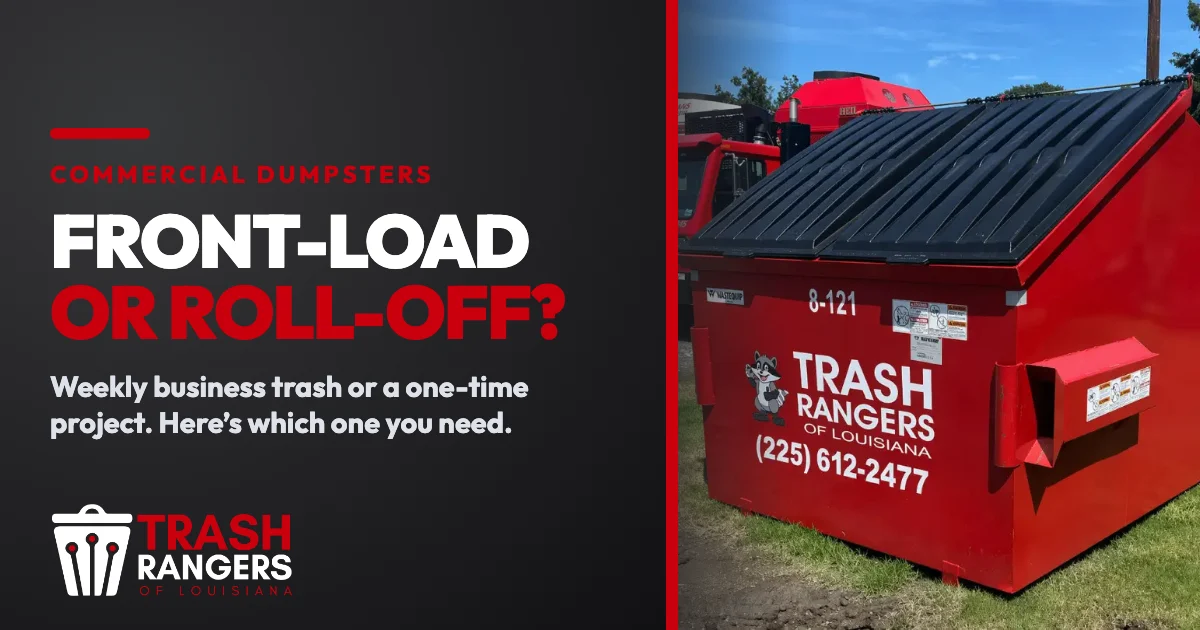

Front-Load or Roll-Off for a Baton Rouge Area Business
A front-load dumpster is for the trash your business makes every week. It stays behind your building, and we empty it on a set schedule, anywhere from 1 to 6 times a week. A roll-off is for a one-time pile from a remodel, build-out, or cleanout. It’s delivered, filled, and hauled away. Most businesses run on a front-load and add a roll-off when a project comes up.
TLDR:
- Front-load dumpsters handle steady, everyday business trash on a recurring pickup schedule.
- Roll-off dumpsters handle one-time projects: renovations, build-outs, demolition, and big cleanouts.
- We run front-load dumpsters in 2, 4, 6, and 8 yard sizes and roll-offs in 15, 20, and 30 yard sizes.
- The EPA estimated 600 million tons of construction and demolition debris in 2018, more than twice the country’s everyday trash. That debris is roll-off work, not front-load work.
- Truck access decides placement. A front-load truck lifts over its cab, and a roll-off truck needs a long, straight approach.
- Construction debris and bulky items don’t belong in a front-load container.
- Plenty of businesses keep a front-load year-round and bring in a roll-off when a project hits.
If you run a restaurant in Gonzales, an office in Baton Rouge, or a shop in Denham Springs, you’ve probably seen both kinds of dumpster and wondered which one you’re supposed to have. The answer isn’t about size first. It’s about how your waste shows up: a little every day, or a lot all at once.
Not sure which one your business needs? Tell us what you throw away, how much, and where the container would sit. We’ll recommend the right type and size and check that our truck can reach it.
The Real Difference Is How Your Waste Shows Up
A front-load dumpster is a service. A roll-off dumpster is a rental. That one distinction explains almost everything else about them.
A front-load container lives at your business. It has a lid, it sits in an enclosure or against the back of the building, and a truck comes by on a schedule to empty it. You don’t think about it much, which is the point.
A roll-off container shows up for a specific job. It’s open on top, it’s much bigger, and it leaves when the job is done. You fill it once, and it goes.
How a Front-Load Dumpster Works
Front-load dumpsters come in 2, 4, 6, and 8 cubic yard sizes, and we can empty them anywhere from 1 to 6 times a week. The right setup is the one that holds your trash between pickups without the lid popping open.
The name comes from the truck. A front-load truck has two forks on the front. The driver lines up square with the container, slides the forks into the sleeves on its sides, and lifts it up and over the cab to dump it into the body of the truck. Then it goes right back where it was.
Aidan, one of our front-load drivers, describes the job simply: “We go ahead and we go and pick up dumpsters, and we dump them back in our truck. It’s all commercial.”
That’s why front-load service fits steady waste so well. Your container never leaves, the pickup day is predictable, and if your volume changes, we change the size or the number of pickups instead of starting over. If you’re stuck between two of the four sizes, our guide to commercial dumpster sizes matches common business types to each one.
How a Roll-Off Dumpster Works
Roll-off dumpsters come in 15, 20, and 30 yard sizes, and they exist for waste that shows up in one big wave. A roll-off truck tilts its bed, slides the container off at your spot, and comes back to winch it up and haul it away once it’s full.
That wave is usually construction and demolition debris. In 2018, the EPA estimated that 600 million tons of construction and demolition debris were generated in the United States, more than twice the amount of everyday municipal trash. The same EPA analysis found demolition makes up more than 90 percent of it.
That’s the kind of material a front-load container was never built for. Drywall, lumber, brick, concrete, and old shingles are heavy and awkward, and they come out of a job site by the truckload, not by the bag.
A roll-off also doesn’t need a permanent home. It sits in a parking lot or beside a building for the length of the project. If you’re deciding between roll-off sizes, the comparison of 15, 20, and 30-yard dumpsters walks through what each one holds and why heavy debris changes the math.
Which One Your Waste Calls For
Here’s the test we use when a business calls us. Picture your trash over a normal month, and ask what it looks like.
If it’s a steady stream of bags, boxes, and food waste, you need a front-load. That’s everyday trash, and there’s a lot of it: the EPA’s national overview of municipal solid waste puts 2018 generation at 292.4 million tons, about 4.9 pounds per person per day. A business produces its share of that every single week.
If it’s one big pile from a single event (a renovation, a tenant build-out, clearing out a warehouse), you need a roll-off. And if it’s both, you need both.
Site Access Decides Where Either One Can Go
Before size or price, there’s a more basic question: can the truck get to it? Plenty of placements that look fine on paper don’t work in real life.
A front-load truck needs to approach the container square and lift it over the cab. That means open air above the container, with no low tree limbs, power lines, or awnings, plus a straight run in and enough room to turn around and leave. An enclosure gate that swings the wrong way can block a pickup just as surely as a parked car.
A roll-off truck has a different problem. It needs a long, straight approach to slide the container off the back, and a firm surface to set it on. After a wet week in South Louisiana, soft ground beside a pad is a real concern for a loaded truck.
This is why we look at the spot before we place either one. A satellite photo won’t show you a low limb or a slope, and a pickup that can’t happen is worse than no container at all. Our property manager’s guide to shared dumpsters covers the most common access problems we see at Baton Rouge area properties.
What Goes in Each (and What Doesn’t)
The simplest way to keep either container working is to put the right waste in it. Most extra charges and missed pickups trace back to the wrong material in the wrong box.
A front-load container is for everyday trash. Bagged garbage, flattened cardboard, packaging, and bagged food waste. It isn’t meant for construction debris, furniture, or big bulky items, and most of that won’t fit through the lid anyway.
A roll-off is for project debris and cleanouts. The EPA’s list of construction and demolition materials includes wood, drywall, brick, concrete, asphalt shingles, and steel, which is a good picture of what goes in a roll-off on a typical job.
Neither is for hazardous waste. Paints, solvents, chemicals, and batteries need their own handling. If you’re not sure about something, ask before it goes in the container. It’s a two-minute phone call that can save you a return trip.
One more note on roll-offs: heavy debris fills the weight allowance before it fills the box. Concrete, dirt, and shingles are dense, so we confirm the right size and weight allowance for your project before the container goes out.
When a Business Needs Both
The most common setup we see isn’t one or the other. It’s a front-load that stays year-round, plus a roll-off that shows up when something big is happening.
A restaurant renovating its dining room still has a kitchen running every day. A retail center with a tenant build-out still has cardboard coming out of every other store. An apartment community still has weekly trash during move-out season, when furniture and bulky items show up all at once.
In each case, trying to push the project waste through the everyday container causes overflow, and it leaves no room for the trash the container was meant for. Adding a roll-off for the project window keeps the front-load doing its normal job. When the project ends, the roll-off leaves and nothing else changes.
Our complete commercial dumpster rental guide covers sizing for both types in one place if you’re planning for a whole property.
Front-Load and Roll-Off Questions, Answered
Quick answers to what Baton Rouge area businesses ask us most when they’re choosing between the two.
Can I put construction debris in a front-load dumpster?
No. A front-load container is built for everyday bagged trash and cardboard, and construction debris like drywall, lumber, and concrete is too heavy and bulky for it. Loading it with debris can cause overflow and a missed pickup. For a remodel or build-out, a roll-off is the right container for the job.
How often can a front-load dumpster be emptied?
We can empty our commercial front-load dumpsters anywhere from 1 to 6 times a week. The right schedule depends on how much trash your business makes between pickups. If your container is full a day or two early most weeks, adding a pickup often solves it without moving to a bigger size.
What front-load and roll-off sizes do you offer?
We run front-load dumpsters in 2, 4, 6, and 8 cubic yard sizes for ongoing business trash. For projects, we offer roll-off dumpsters in 15, 20, and 30 yard sizes. We’ll recommend the right size once we know what you’re throwing away and where the container would sit.
Can I have a front-load and a roll-off at the same time?
Yes, and it’s common. Many businesses keep a front-load year-round for everyday trash and add a roll-off during a renovation, tenant build-out, or cleanout. The roll-off handles the project debris, the front-load keeps handling daily waste, and the roll-off leaves once the project is done.
How much space does each type of dumpster need?
It’s less about square footage and more about access. A front-load truck needs a straight approach and clear space overhead to lift the container over its cab. A roll-off truck needs a long, straight approach and a firm surface. We look at the spot before placing either container.
Do you service businesses outside Baton Rouge?
Yes. We provide commercial dumpster service across East Baton Rouge, Ascension, and Livingston Parishes. Our service areas page has the current coverage map, and a quick call will confirm service at your exact address before anything is scheduled or delivered.
Ready to set up service? For ongoing business trash, start a front-load account. For a project, reserve a roll-off. Not sure? Call us, and we’ll sort it out in one conversation.