
What Is a Concrete Washout Box, and Who Needs One?
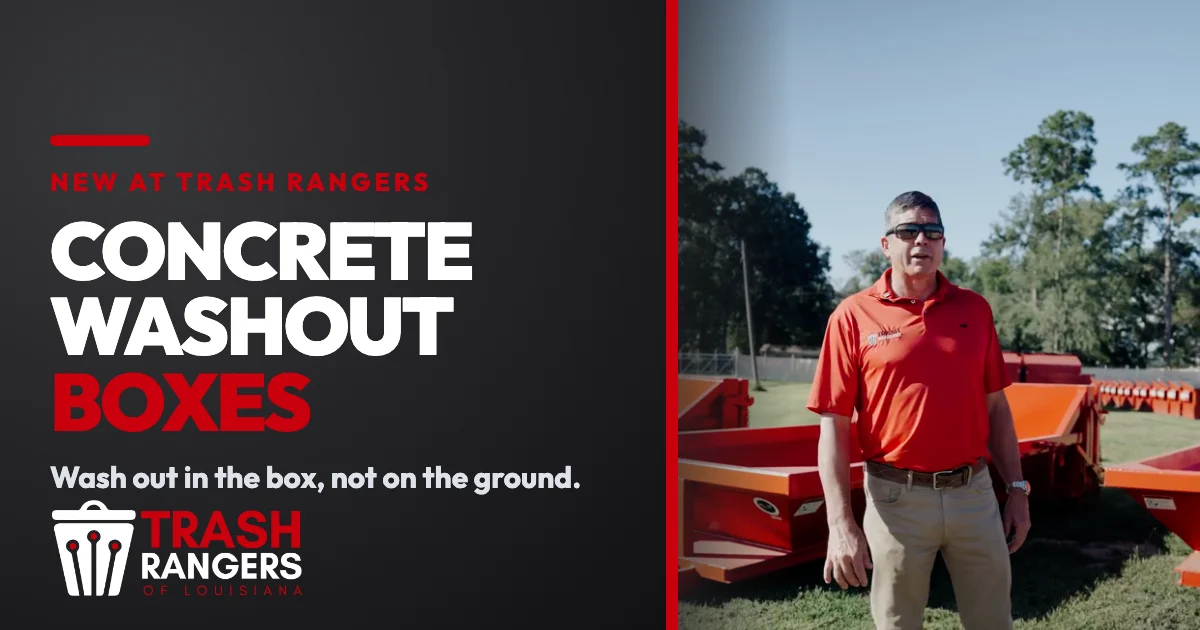
A concrete washout box is a portable container that catches the leftover slurry when a ready-mix truck cleans up after a pour. Instead of rinsing the chute onto the dirt, the driver washes into the box. Trash Rangers now carries these boxes for contractors and big construction jobs across the Greater Baton Rouge area.
TLDR:
- A concrete washout box catches chute rinse and leftover slurry so it never hits the ground.
- Washout water is caustic, and the EPA measures its pH near 12.
- Louisiana construction stormwater permits prohibit concrete washout wastewater unless it is managed by an appropriate control.
- Rinsing the chute on site and washing out the drum are treated very differently by LDEQ.
- The permittee, usually the general contractor, carries the compliance responsibility, not the ready-mix driver.
- Trash Rangers has the boxes in the yard now. Call (225) 612-2477 and we will get you set up.
If you have poured a slab in Ascension Parish in August, you already know the sequence. The truck backs in, the pour goes down, and then the driver needs to clean the chute before the mix sets up. On a lot of Louisiana jobsites, that rinse ends up in the corner of the yard, in a low spot, or in whatever ditch is closest. It looks harmless. It is the single easiest way to draw a stormwater violation on an otherwise clean site.
Have a pour coming up? Tell us the site and the schedule, and we will get a concrete washout box out to you.
Why Washing Out on the Ground Causes Problems
The mess is the visible part. The chemistry is the part that gets cited.
The EPA describes concrete washout water as a slurry containing toxic metals that is also caustic and corrosive, with a pH near 12. For reference, the same agency puts the safe pH range for freshwater aquatic habitat at 6.5 to 9. That gap is why a puddle of gray water is treated as a pollutant discharge and not as housekeeping.
The EPA fact sheet also spells out the path. Washwater dumped on the ground can run off the site to adjoining roads, enter roadside storm drains, and reach rivers, lakes, or estuaries. Rain can also carry it down through the soil, change the soil chemistry, and reach groundwater. In a parish with the water table Baton Rouge has, neither route is theoretical.
Workers are exposed too. OSHA’s guidance on Portland cement, published in 2008, warns that wet cement can cause caustic burns that may not hurt at the time, and it lists ready-mixed concrete truck drivers among the workers at risk. Containing the washout keeps it off boots and out of standing puddles.
What Louisiana Actually Requires on a Jobsite
Most contractor articles on this topic quote the federal permit. In Louisiana, that is the wrong document to be reading.
Louisiana has run its own version of the federal stormwater program since 1996, so construction sites here fall under LDEQ’s LPDES general permits rather than the EPA Construction General Permit. Coverage is split by size. The small construction permit, LAR200000, covers sites disturbing at least one acre and less than five. The large construction permit, LAR100000, picks up at five acres and above. Both count smaller parcels that are part of a larger common plan of development.
Both permits list wastewater from washout of concrete as a prohibited discharge unless it is managed by an appropriate control. They also go further than the federal text and give concrete trucks their own section, titled Wash Water from Concrete Trucks. That section tells contractors the rinse must be done so that no rinse water runs off the site, especially into surface drainage, storm sewers, or surface waters.
There is one line in that section that catches people. LDEQ says the washout structure is temporary and must be cleaned out and removed when the project is finished, and that the LDEQ Solid Waste Permits Section must be notified to determine if additional rules govern how the washout material is contained and stored on site. That is a phone call most crews never make.
Not sure what your site needs? We rent the box. Your stormwater consultant or LDEQ confirms the paperwork.
Chute Rinse Versus Drum Washout: The Line That Matters
These two phrases get used interchangeably on jobsites. The permits do not treat them the same way.
LDEQ allows the rinsing of a concrete truck chute at the construction site when it is managed by an appropriate control, and describes that rinse as a small quantity that can be handled on site. Washing out the drum is a different matter. Both Louisiana permits state plainly that the permit does not authorize the discharge of drum washout water at a construction site. The drum has to be washed out at a ready-mix plant permitted to take that water.
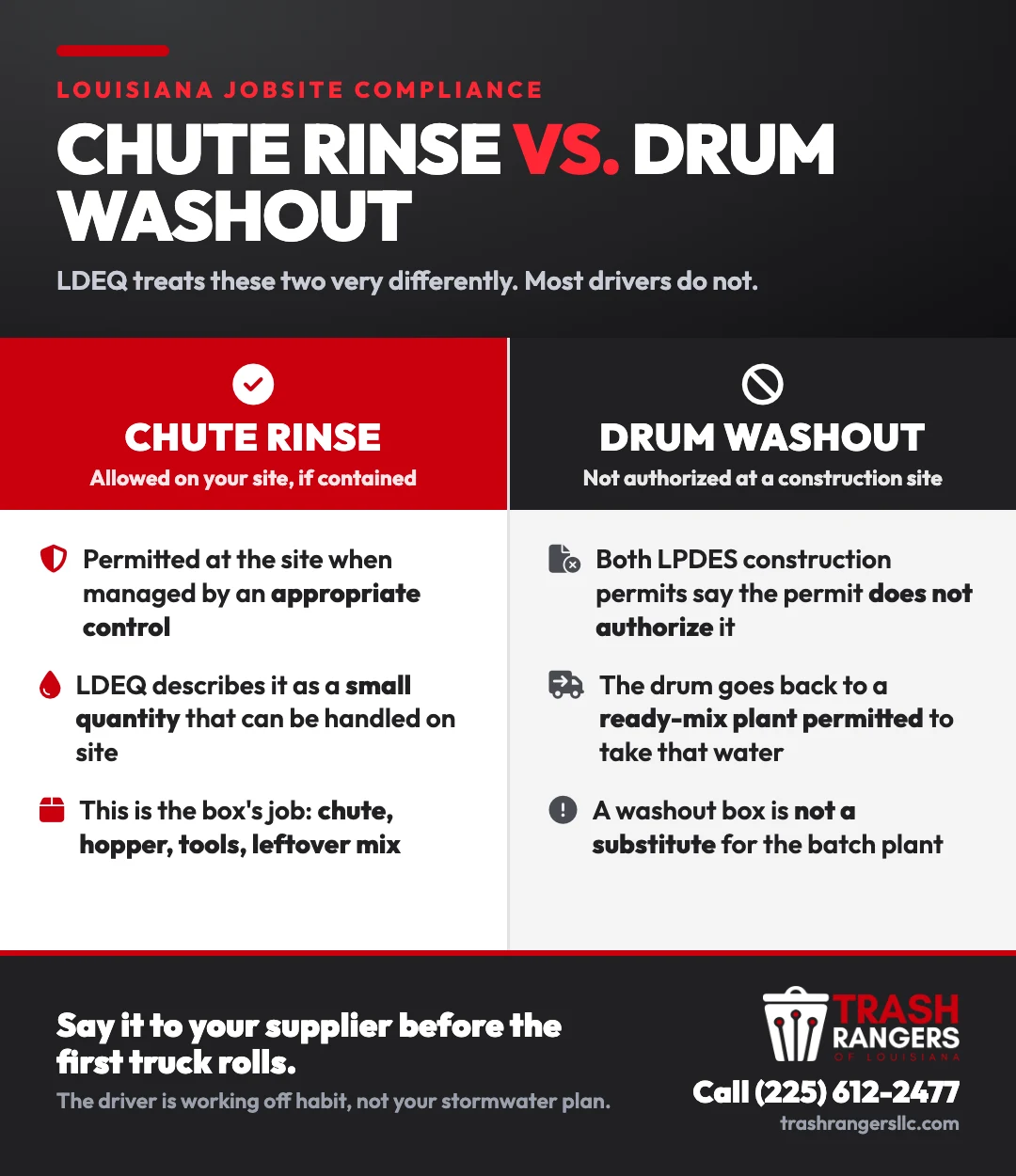
The split above is the part worth showing your crew, because the two jobs look almost identical from across the site.
So a washout box on your site is there for chute rinse, hopper rinse, tools, and leftover mix. It is not a substitute for the batch plant. Say that out loud to your ready-mix supplier before the first truck rolls, because the driver is working off habit.
Why a Container Beats a Hay-Bale Pit
Plenty of crews still build a pit out of hay bales and plastic sheeting. The EPA fact sheet is unusually direct about how that goes.
Trucks damage the bales and the plastic, so the pit has to be repaired and relined. When the hardened solids come out, they are often bound up with the liner, which means they go to a landfill instead of a recycler, because recyclers generally take only unmixed material. Concrete pump trucks are a separate problem: the fact sheet notes that their low hopper may physically prevent them from washing into a bale-lined pit.
The same EPA document describes the metal roll-off bin as designed to securely contain washwater and solids, portable, reusable, and fitted with a ramp, so pump trucks can wash out their hoppers. CASQA’s construction BMP handbook, updated in 2023, likewise lists portable removable containers as an accepted above-grade washout facility and says the container should be sealed against leaks and swapped when it reaches 75 percent capacity.
Where the Box Goes and How to Keep It Right
Placement is the part that turns a good control into a useless one. A sealed box ten feet from a curb inlet still puts you one hard rain from a citation.
Both the EPA fact sheet and the CASQA handbook recommend keeping washout facilities at least 50 feet from storm drain inlets, open drainage, and watercourses. Note that this is guidance rather than permit text: the permits themselves say to locate washout as far from those features as possible. Fifty feet is the number your inspector will have in mind.
A short maintenance routine covers the rest:
- Inspect daily and after heavy rain for leaks and damage.
- Swap or service the box at about 75 percent full, before it can slosh over.
- Lower the liquid level or cover the box ahead of a storm so a downpour cannot overflow it.
- Sign the location so every driver on the site uses the same spot.
- Tell the site superintendent where it is, and put washout expectations in the concrete supply contract.
That last item comes straight from the EPA fact sheet, and it is the cheapest insurance on the list.
Who Is on the Hook if It Goes Wrong
Contractors often assume the ready-mix company owns this risk. The permit language points the other way.
Under the federal definition that Louisiana mirrors, the operator is the party with operational control over the plans and specifications, or with day to day control of the work needed to comply with the permit. Where several operators share a site, all of them need coverage, and subcontractors generally are not treated as operators.
LDEQ’s large construction permit adds a second layer. A permittee controlling only part of a site is still responsible for the control measures tied to their own activities, and has to keep those activities from defeating another party’s controls.
In plain terms: the general contractor or developer holding the permit answers for the washout, and noncompliance is a violation of both the Clean Water Act and the Louisiana Environmental Quality Act. That is why the box is worth ordering with the concrete, not after somebody rinses a chute into the grass.
Getting a Concrete Washout Box from Trash Rangers
We are a local hauler, so the ordering part is short.
The boxes are in our yard now. They are built for contractors and big construction jobs, and they do exactly what the name says: when the pour is finished and the truck has to clean up, the driver washes into the box instead of onto the ground, and the site stays clean. If you already rent roll-off dumpsters from us for demo or debris, a washout box drops into the same delivery schedule.
Call us with the site address, the pour date, and how many trucks you expect, and we will confirm box sizing, placement, and swap timing for your job. We also handle the rest of the container side of a jobsite, from commercial dumpster sizing to construction debris hauling across our Baton Rouge area service map.
Concrete Washout Questions Baton Rouge Contractors Ask
These are the questions that come up on the first call, answered in the order people usually ask them.
What is a concrete washout box?
It is a portable, sealed container placed on a jobsite to catch the slurry from rinsing a ready-mix chute, a pump truck hopper, and concrete tools. The material hardens inside the box, and the box is hauled away instead of the waste soaking into the ground.
Can a concrete truck wash out on the ground in Louisiana?
No, not as an unmanaged discharge. Both LDEQ construction stormwater permits list wastewater from concrete washout as a prohibited discharge unless it is managed by an appropriate control, and require that rinse water not run off the site into drainage, storm sewers, or surface waters.
What is the difference between rinsing the chute and washing out the drum?
LDEQ allows chute rinsing at the site when it is contained, calling it a small quantity. Drum washout is not authorized at a construction site at all. The drum has to be washed out at a ready-mix plant permitted to discharge that water.
How far from a storm drain should a washout box sit?
EPA’s washout fact sheet and CASQA’s construction handbook both recommend at least 50 feet from storm drain inlets, open drainage, and watercourses. The permits themselves say as far away as feasible, so 50 feet is the practical target to plan around.
Who is responsible for concrete washout compliance on a jobsite?
The permittee, which is normally the general contractor or developer with operational control of the site. Subcontractors generally are not treated as operators. EPA also advises writing washout requirements into the contract with the concrete supplier.
Does a small job need a concrete washout box?
Permit coverage in Louisiana starts at one acre of disturbance, or less if the parcel is part of a larger plan that reaches an acre. Below that threshold you may not hold an LPDES permit, but dumping caustic slurry where it can reach a ditch is still a problem. Containing it is the safer call on any pour.
How do I rent a concrete washout box in Baton Rouge?
Call Trash Rangers at (225) 612-2477 with the site address and your pour schedule. We will confirm what fits the job and get it delivered with the rest of your containers.
Keep the pour off the ground. Trash Rangers has concrete washout boxes in the yard now, for contractors and big jobs across Ascension, Livingston, and East Baton Rouge. No surprise fees, because what we say is all you pay.