
The Atlantic hurricane season runs June 1 through November 30 every year, and the 2026 NOAA outlook released in May projected 8 to 14 named storms with 3 to 6 hurricanes and 1 to 3 major hurricanes — though forecasters give the season a 55% chance of running below the long-term average. Below-normal still means real risk in south Louisiana. Hurricane Francine made landfall in Terrebonne Parish in September 2024 and earned FEMA disaster declaration DR-4817-LA, with Ascension Parish included for Individual Assistance and Categories A and B (debris removal). Hurricane Ida in 2021 generated more than a million cubic yards of debris in Livingston Parish alone.
That’s the context. Here’s what Ascension and Livingston Parish homeowners actually need to know about handling storm debris — before, during, and after a system rolls through.
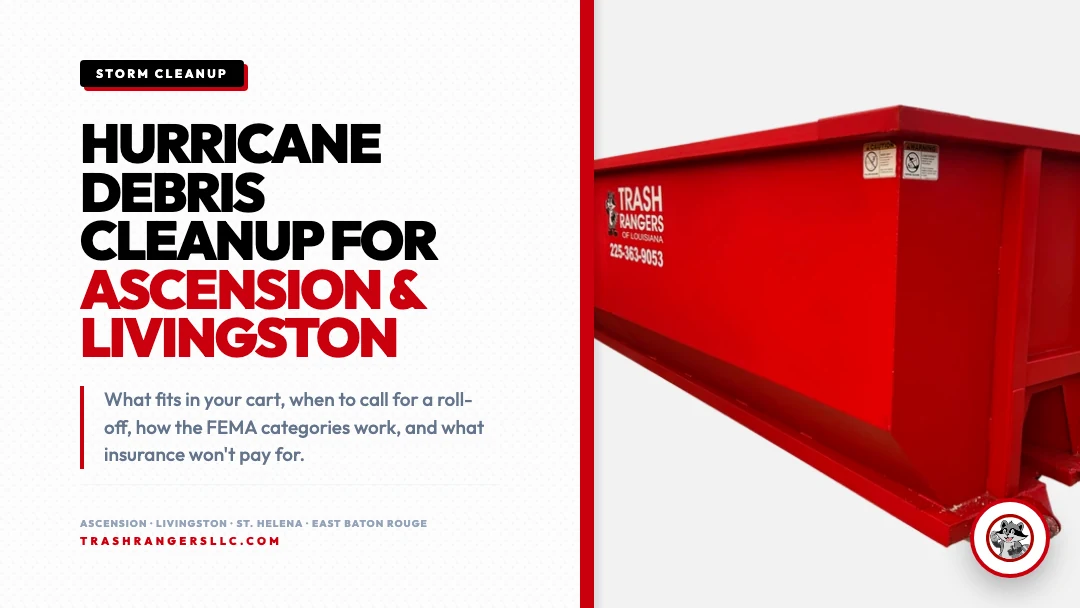
Most household trash still goes in your regular cart on its normal pickup day, but storm debris — tree limbs, fencing, water-damaged drywall, ruined furniture — doesn’t fit that workflow. Vegetative debris and construction and demolition (C&D) debris each go in separate piles at the curb. Appliances, electronics, and household hazardous waste (HHW) like paint, batteries, and pesticides go to dedicated drop-off, not the curb. For volume beyond what a few separated piles can hold, a 15-, 20-, or 30-yard roll-off is the right tool — typically 6, 8, or 12 pickup-truck loads of capacity respectively. If a federal disaster declaration is issued for your parish, parish-contracted debris removal kicks in on public right-of-way only; private property is your responsibility unless FEMA authorizes Private Property Debris Removal (PPDR), which requires a specific public-health-threat finding. Your homeowner’s policy typically caps debris-removal coverage at $500 or 5% of Coverage A — read the policy before paying anyone.
TLDR:
- Atlantic hurricane season is June 1 through November 30 — NOAA’s 2026 outlook projects 8 to 14 named storms with 1 to 3 majors, even with a below-normal expectation.
- Separate your debris into 6 categories — vegetative, construction and demolition, appliances and white goods, electronics, household hazardous waste, and normal trash. Ascension Parish requires this separation explicitly, and mixed piles get skipped.
- Private-property debris removal is the homeowner’s responsibility unless FEMA authorizes PPDR for a specific declared disaster — confirmed in FEMA’s Public Assistance Category A guidance.
- Most homeowner policies cap debris removal at $500 per tree or 5% of Coverage A per the Louisiana Department of Insurance hurricane resource center — read your policy before paying anyone.
- Waterlogged debris weighs 2 to 3 times more than dry — a 30-yard roll-off of wet drywall and carpet can hit its weight cap before it’s full. Pickup-truck-equivalent capacities: 15-yd ≈ 6 loads (1-2 tons), 20-yd ≈ 8 loads (2-3 tons), 30-yd ≈ 12 loads (3-5 tons).
- EBR Parish residents are locked into the Republic Services contract through 2033. Ascension and Livingston residents can call their local hauler directly for storm response — that single difference shows up most after a hurricane.
What Hurricane Debris Actually Looks Like in Ascension and Livingston
Recent storms set the baseline for what Ascension and Livingston Parish residents should plan for. After Hurricane Ida in 2021, Livingston Parish News reported the parish reached 711,774 cubic yards of vegetative debris plus 9,270 cubic yards of construction and demolition debris by mid-October 2021, with cumulative totals topping a million cubic yards by November. Ascension Parish removed roughly 154,121 cubic yards by November 19 of the same year, per local reporting in The Advocate.
The texture of the debris matters more than the volume. Wet drywall, soaked insulation, sopping carpet, downed live oak limbs, broken fencing, ruined patio furniture, lost shingles, dead refrigerators full of spoiled food. A single mid-storm fallen tree can fill a 20-yard roll-off on its own once the limbs are down to chip-and-haul size. A whole-house water intrusion can require a 30-yard plus a second pull. Cleanup is not a single afternoon.
Tree removal in particular runs heavy in south Louisiana because the mature canopy is heavy on live oak and pecan. For storm-felled trees, expect crane-required scenarios to be common when the tree is leaning toward a structure or has dropped already with the root plate visible.
Before the Storm: A Real Pre-Hurricane Cart Checklist
72 to 24 hours before landfall is when the prep matters. The single biggest mistake is putting debris curbside before the storm — high winds turn that debris into projectiles. The second-biggest is missing your last pre-storm pickup because you forgot the schedule.
Practical pre-storm checklist for Ascension and Livingston households:
- Bring carts in or strap them down. Empty carts blow over and around the neighborhood; full carts spill and become projectile-launchers.
- Secure loose yard debris — patio furniture, planters, grills, kids’ toys, decorative items. Bring inside or tie down.
- Do NOT pre-stage debris at the curb. A pile of yard waste pre-storm becomes shrapnel during. Wait until after the all-clear.
- Take photos of your property for the insurance baseline. Inside, outside, attic, and especially tree condition. This matters for both claim documentation and the Louisiana Civil Code Article 2317.1 liability questions about pre-existing tree defects.
- Document tree condition before the storm. A documented inspection by a licensed Louisiana arborist (LDAF Horticulture Commission licensure required) is the only insurance-defensible record of pre-storm tree health.
- Verify your pre-storm pickup happens on schedule. If service is canceled for the storm window, your cart sits unemptied until after the all-clear. Plan accordingly.
- Save the LDEQ Debris Hotline number: 225-364-7901, per the Louisiana Department of Environmental Quality disaster debris management page. You’ll want this if you encounter a hazardous-waste question post-storm.
Immediately After: Safety Before Cleanup
Storm cleanup injuries spike in the 24-48 hours after the all-clear because tired homeowners pick up chainsaws to clear their own driveway. BLS 2024 Census of Fatal Occupational Injuries data ranks refuse and recyclable material collectors at 37.4 fatalities per 100,000 full-time workers — the fifth most dangerous occupation in the country. Tree workers, electricians, and roofers all run in the same risk band. None of that is amateur work.
Safety priorities in the first 24 hours:
- Downed power lines — assume any down line is live. Stay 35 feet away and call the utility company. Don’t move debris near a line.
- Gas smell — evacuate, don’t operate any electrical equipment, and call your gas utility from a safe distance.
- Structural sag — visible roof sag, walls bowing out, doors that won’t close because the frame moved. Don’t enter, call structural assessment.
- Standing water + electrical — assume any wet area near an outlet is hot. Turn off the breaker for the affected zone before touching anything.
- Chainsaw rules — never operate fatigued, never operate alone, always wear eye and ear protection plus chaps. If the tree is on a structure, on a power line, or leaning toward either, that’s a licensed arborist’s call, not a homeowner’s.
Document everything before you move it. The insurance adjuster’s first ask is photos.
24 to 72 Hours: What Fits Where
This is when the volume question becomes real. Regular residential curbside service typically resumes 24 to 48 hours after the all-clear in Ascension and Livingston Parishes — assuming roads are passable. But your normal 96-gallon cart was designed for a week of household trash, not the contents of a flooded garage.
The clean rule is: household trash still goes in the cart on its normal day. Storm debris does not.
For volume beyond what fits in 2 to 3 weeks of cart pickups, a roll-off is faster, cheaper per cubic yard, and doesn’t depend on the regular route truck having capacity. Trash Rangers offers 15-, 20-, and 30-yard roll-offs — pickup is on your schedule, not a parish queue. Local haulers can typically dispatch a roll-off within 24 to 48 hours when their crews aren’t deployed to a federally declared event.
The 6 Categories Your Curb Pile Must Separate Into
Mixed piles get skipped. Both Ascension Parish’s post-hurricane debris pickup page and Livingston Parish Public Works require separation into specific categories. The contractors hauling parish-funded debris removal sort by category at the disposal site; piles that mix vegetative with C&D with appliances don’t fit the equipment workflow and get bypassed.
The six categories you’ll see in any Louisiana parish debris management plan:
- Vegetative debris — tree limbs, branches, leaves, root balls. Goes to the green-waste pile or curbside yard waste collection.
- Construction and demolition (C&D) — drywall, lumber, shingles, tile, brick, fencing, insulation. Cannot go in the residential cart.
- Appliances and white goods — refrigerators, washers, dryers, stoves, freezers, water heaters. Refrigerant-containing units (fridges, AC units) require Freon recovery before disposal. Set out separately.
- Electronics — TVs, computers, monitors, microwaves. Many parishes operate dedicated e-waste collection events.
- Household hazardous waste (HHW) — paint, paint thinner, automotive fluids, pesticides, herbicides, fertilizers, pool chemicals, batteries, propane tanks. Do NOT put any of these at the curb. Take to a designated HHW collection site or call LDEQ at 225-364-7901.
- Normal trash — household garbage that fits the regular cart. Goes on the normal pickup day, separate from any storm-debris piles.
Mixing any two of those categories at the curb means the pile gets skipped. Skipped piles sit on your right-of-way until the next pass through your street — which can be weeks during peak debris removal periods.
When a Federal Disaster Declaration Changes Everything
Federal disaster declarations trigger a separate workflow. When the President declares a federal disaster for your parish — as happened with DR-4817-LA for Hurricane Francine in September 2024 and Ascension Parish was included for Individual Assistance and Categories A and B (debris removal and emergency protective measures) — parish-contracted debris removal kicks in on public right-of-way. Crews drive your street picking up sorted curbside piles funded under FEMA Public Assistance Category A.
What that program covers and what it doesn’t:
- Public right-of-way: covered. Vegetative and C&D debris placed at the curb (not on your driveway, not behind the fence) gets picked up at no cost to the homeowner.
- Private property: NOT covered by default. FEMA’s Category A guidance is explicit that private-property debris removal (PPDR) is the homeowner’s responsibility unless FEMA specifically authorizes PPDR for a particular declared disaster — and PPDR authorization requires a finding of widespread public-health threat. It’s not the default.
- HHW, appliances, and electronics: typically NOT covered by the FEMA Cat A program. These go to dedicated parish collection events or local hazardous-waste sites.
- Reimbursement of homeowner cleanup expenses: FEMA Individual Assistance can sometimes reimburse uninsured cleanup costs, but insurance is always primary. Keep every receipt.
The practical impact for Ascension and Livingston Parish homeowners: even when a federal declaration arrives, you’re still responsible for your own property. The parish-contracted crews work the right-of-way. What you cut up and drag to the curb gets picked up; what stays inside the property line is your problem to schedule.
What Your Insurance Actually Covers (Spoiler: Less Than You Think)
Standard Louisiana homeowner policies typically cap debris removal at $500 per tree or 5% of Coverage A — and that cap kicks in only when a covered peril caused the damage. Practical translation:
- Tree falls on insured structure: typically covered up to the per-tree cap.
- Tree falls in the yard, no structure damage: usually NOT covered. The tree on the lawn is your problem.
- Tree was already dead or dying before the storm: covered only if you can document you didn’t know about the defect. The Louisiana Civil Code Article 2317.1 liability framework requires owners to act on known defects.
- Debris from a neighbor’s property blown onto yours: typically your insurance, not theirs, unless the neighbor’s tree had a documented defect.
- Flood debris: NOT covered by standard homeowner insurance. Only NFIP flood insurance covers flood-related debris removal, subject to that policy’s own caps.
The single best practice: read your policy before paying anyone for cleanup. Get the per-tree cap, the Coverage A percentage cap, and the aggregate claim cap in writing. Most cleanup disputes come from homeowners assuming higher coverage than they actually have.
The Local-Hauler Advantage in Storm Response
Storm response is the single sharpest difference between a local hauler and a national one. Local drivers live in the parishes they serve. The truck that picks up your normal Wednesday route is the same truck — same driver — that comes back the Thursday after a storm clears. National-fleet operations route across multiple states; their post-storm response involves regional dispatch coordination that adds 24 to 72 hours before a service ticket gets cleared.
East Baton Rouge Parish residents next door have no choice in the matter. Republic Services holds the EBR parish residential contract through 2033, with a 4% annual fee escalator pushing the per-household monthly rate toward $40 by the end of the contract. Whoever Republic dispatches to your EBR street after the storm is who you get. You can’t switch, can’t bring in a local hauler for the cleanup, can’t compete the work.
Ascension and Livingston Parish residents have the opposite situation. You can call a local roll-off hauler directly. You can ask for same-week delivery. You can ask for a follow-up pull when the first dumpster fills. You can ask for an HHW-aware crew. That flexibility shows up most after a storm — when the workflow is least predictable and the value of a hauler who actually picks up the phone is highest.
For the broader picture on parish-by-parish residential service in this area, see our complete local trash service guide for Ascension and Livingston Parishes. And for the related question of what changes when you actually move out of EBR Parish, our moving-out-of-EBR walkthrough covers the transition.
Common Questions About Hurricane Debris in Ascension and Livingston
These are the questions Ascension Parish and Livingston Parish homeowners ask after a storm — usually in the first 24 hours when the cleanup decisions are most uncertain.
What goes in my regular trash cart after a hurricane?
Only household garbage that would have gone in the cart on a normal week. Bagged food waste, normal household refuse. No yard debris, no construction or demolition debris (drywall, shingles, fencing), no appliances, no electronics, no hazardous waste. Mixing storm debris with regular trash gets the cart flagged and skipped on the next pickup.
Will FEMA pay for my hurricane debris cleanup?
Only on public right-of-way after a federal disaster declaration for your parish, and only for vegetative and C&D debris properly separated at the curb. Private-property debris removal is the homeowner’s responsibility unless FEMA authorizes PPDR for the specific event — which requires a finding of widespread public-health threat. Don’t assume FEMA covers everything.
How big a roll-off do I need for hurricane cleanup?
It depends on the damage. For a flooded single room (one bath, one bedroom): a 15-yard usually fits. For a whole-house water intrusion or significant fence and tree damage: a 20-yard. For full demolition cleanup or a multi-room rebuild: a 30-yard with a likely second pull. Waterlogged debris weighs 2 to 3 times more than dry, so the weight cap (not the volume) often becomes the binding constraint.
Can I burn the storm debris on my property?
Open burning of storm debris on private property is restricted under Louisiana state and parish regulations. Check with Louisiana DEQ and your parish before starting a burn pile. After major hurricanes, parish-wide burn bans are typical for the first weeks because air quality and wildfire risk both spike.
My tree fell across my driveway and into the neighbor’s yard. Who handles it?
The portion on your property is your responsibility. The portion on the neighbor’s property is technically theirs, but the practical workflow is: one crew, one cleanup. Coordinate with the neighbor before you call. If the tree was dead or visibly defective before the storm, Louisiana Civil Code Article 2317.1 may shift liability based on whether the owner knew or should have known about the defect.
Why is my hauler taking longer than usual to respond?
Routes after a storm work in waves. Highest-priority work — clearing main collector streets, restoring access for emergency vehicles — happens first. Residential debris pickup follows once roads are passable. Add 24 to 48 hours after the all-clear for residential routes to fully resume in Ascension and Livingston. Local haulers are typically faster than national-fleet operations because dispatch happens at the local office, not via regional escalation.
Storm hit and you need a roll-off?
Trash Rangers dispatches 15-, 20-, and 30-yard roll-offs across Ascension and Livingston Parishes — usually same-week when scheduling allows. Pickup is on your timeline, not a parish queue. Local drivers, local dispatch, no regional coordination delays.
Call for a same-day quote, or sign up online.
About the author
Jake Poche — Owner, Trash Rangers. Trash Rangers of Louisiana, LLC is a Baton Rouge-area waste services company serving residential trash collection, commercial dumpster rental, and event sanitation across Ascension Parish, East Baton Rouge, and the surrounding parishes. The company is registered as a Louisiana State Contractor (License #71067), holds an A+ BBB rating, and has been operating since August 2020. Learn more about the company at trashrangersllc.com or get in touch through the contact page.