
Most folks in Ascension and Livingston Parishes didn’t actively pick their trash hauler. It came with the house. Or with whatever the previous owner had set up. Or the property manager arranged it. So when something goes wrong — a missed pickup, a surprise fee jump, a cart left at the curb three weeks running — most people aren’t sure what their options actually are.
Here’s the thing: in Ascension and Livingston, you actually have options. Unlike East Baton Rouge Parish next door, where residential trash is bundled into a parish contract that runs through 2033, residents in Ascension and Livingston Parishes choose their own hauler. That makes a real difference in price, service quality, and what happens when you call to complain.
In December 2022, the EBR Metro Council voted 8-2 to renew the parish’s residential garbage contract. The headline number: residential fees jumped from $23 to $35.23 per month — a $12.23 increase that WBRZ first reported would push residents toward about $40 per month by 2033 under the contract’s 4% annual escalator. The new fee took effect in March 2023, as WAFB confirmed in its July 2023 EBR garbage rollout coverage. That EBR contract is the cautionary tale next door. It’s also the reason Ascension and Livingston residents value the freedom to choose.
This guide walks through what local trash service looks like across Ascension and Livingston Parishes: who provides it, what it costs, how to evaluate a hauler, and what to do when service goes wrong. It covers all 22 TR-served locales — and uses the EBR situation as context for why your ability to choose matters.
TLDR:
- Ascension and Livingston Parishes together hold roughly 283,000 residents across more than 20 TR-served locales — and unlike neighboring EBR, residents here choose their own residential trash hauler
- EBR residents next door are locked into a Republic Services parish contract whose fees rose 53% in one year (2023) and keep escalating 4% annually through 2033
- In 2018 alone, EBR residents filed nearly 6,000 missed-garbage and roughly 1,000 missed-recycling 311 complaints — prompting Republic Services to apologize publicly in June 2019
- Local haulers compete on route knowledge, response time, and accountability — not fleet scale
- Switching providers in Ascension or Livingston is straightforward; in EBR it’s not possible at all
Who provides residential trash service in Ascension and Livingston Parishes?
According to USAFacts’ 2024 Census Bureau snapshot of Ascension Parish, the parish holds roughly 133,500 residents, with Livingston Parish adding roughly 150,000 more across 12 incorporated and unincorporated communities. Together, that’s around 283,000 people spread across more than 20 locales — Prairieville, St. Amant, Geismar, Sorrento, Donaldsonville, Burnside, Darrow, Dutchtown, Duplessis, and Brittany in Ascension Parish; Denham Springs, Walker, Watson, Albany, French Settlement, Holden, Killian, Livingston (town), Maurepas, Port Vincent, Springfield, and Colyell in Livingston Parish. Local trash service across this footprint is provided by a small set of independent operators — not by the national haulers that dominate the EBR contracted territory.
The contrast with the next parish over is sharp. East Baton Rouge Parish — Louisiana’s largest at roughly 453,000 residents per USAFacts’ 2024 Census data — bundles residential trash pickup into a parish contract with Republic Services. EBR households don’t choose. The parish does. The broader Baton Rouge metro is 882,652 people across 343,718 households per the 2024 American Community Survey, and the freedom to choose your residential hauler is essentially limited to the non-EBR parishes within that footprint.
That contracted-vs-choice split shapes everything else in this guide. Inside EBR, you can’t switch trash service even if you want to — the contract runs through 2033. In Ascension and Livingston, you’re an actual customer. Local trash service across the parishes’ 22 TR-served locales runs on smaller routes, with direct dispatcher access and local employment that doesn’t drift to a corporate office out of state.
National players dominate the broader U.S. industry. Einvesting for Beginners’ Spring 2024 industry report, which aggregates trailing-twelve-month revenue from publicly traded waste haulers, shows three companies — Waste Management (34.1%), Republic Services (25.1%), and Waste Connections (13.5%) — holding a combined 72.7% of U.S. waste industry revenue. The underlying numbers cross-check against Waste Management’s own FY2024 10-K filing with the SEC. The remaining 27.3% is split across roughly 19,462 independent waste-collection businesses nationwide, as IBISWorld tracks in its 2024 industry statistics. Frame that the way the industry rarely does: the independent operator isn’t a niche or a holdout — it’s how the majority of waste-collection companies in America operate. Three corporations hold the lion’s share of the revenue, but they don’t hold the lion’s share of the businesses. Local is closer to default than most folks assume.
For a deeper look at the operational side — how a route actually runs from your curb to the landfill — see our piece on where trash service starts. For a parish-by-parish view of which areas Trash Rangers covers, check the service areas page.
What does residential trash service cost in Ascension and Livingston Parishes?
In Ascension and Livingston, residential trash pricing is set by the provider you choose — not by a single parish contract. That means rates vary by hauler, service tier, cart size, and pickup cadence. To know what’s reasonable, the right benchmark is the next parish over: EBR’s contracted rate is $35.23 per month, rising on a 4% annual escalator built into a contract that runs through 2033. WBRZ’s coverage of the December 2022 Metro Council vote lays out the rate progression, and WAFB’s July 2023 EBR garbage rollout report confirms the $12.23 increase took effect in March 2023. For Ascension and Livingston residents, that contracted EBR rate is the floor most local providers compete against. A separate component of the EBR contract — out-of-cart trash collection by Richard’s Disposal — began September 1, 2023. The relevant takeaway for non-contracted residents is that the EBR rate sets the comparison point, not the cap.
That 2023 jump was a 53% increase in a single year. The contract runs seven years with three optional extension years.
Here’s the math nobody else is doing. At $35.23 per month across the roughly 135,000 households on the EBR contract — a household count The Advocate documented in 2019 alongside the parish’s $26 million annual contract value — the parish is now paying out around $57 million per year for residential trash service. Same household count, same routes, but a 2.2x increase in parish residential trash spend over five years. That’s about $31 million more per year for substantially the same fleet running substantially the same routes. The question isn’t whether the rate is fair. It’s where the difference is going.
What you actually get for $35.23 per month inside the contract: weekly garbage pickup, weekly recycling pickup, a parish-issued cart, and a defined bulk-pickup allowance. What you don’t always get: same-week resolution on a missed pickup, holiday-week reliability, or storm response that doesn’t lag the regional dispatch cycle.
Before assuming you need to upgrade your service tier, read the cart-size and pickup-cadence options on your existing plan. Most BR-area households are well-served by a 96-gallon cart on weekly pickup; upgrading to twice-weekly is rarely the actual fix for capacity issues.
What goes wrong with national-hauler trash service in the Baton Rouge area — and how often?
The Advocate’s 2019 retrospective on EBR garbage service documented that in 2018, residents of East Baton Rouge Parish filed nearly 6,000 missed-garbage complaints and roughly 1,000 missed-recycling complaints through the City-Parish 311 system. The pattern was severe enough that Republic Services issued a public apology in June 2019, as reported by Business Report, and the parish invited re-bids for the contract. That’s roughly 7,000 documented missed-pickup complaints in a single year — and that’s only counting the residents who picked up the phone.
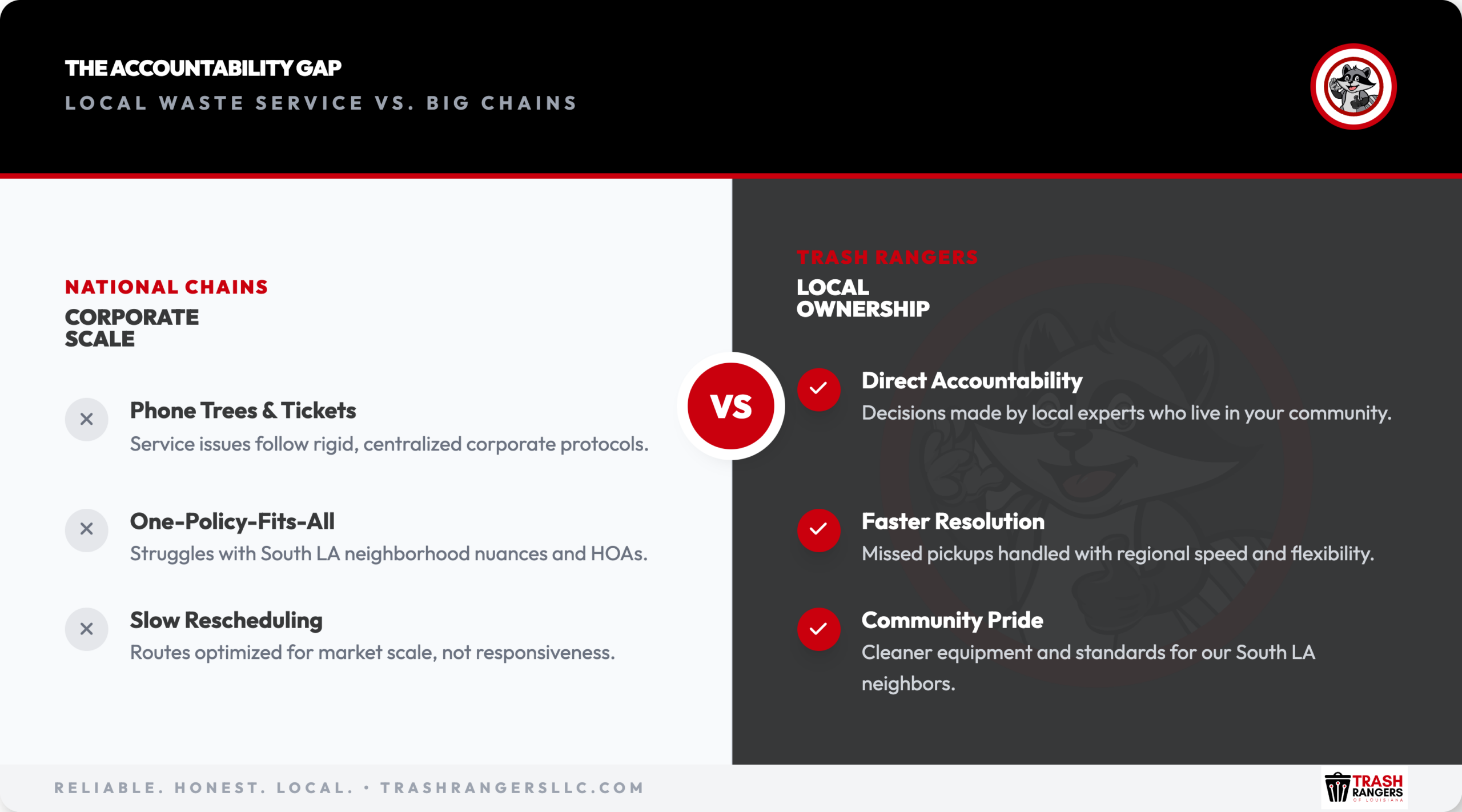
Why does this happen at scale? The structural causes are well-understood in the industry: route density mismatches, driver turnover, equipment cycling between regions, holiday-week scheduling confusion, and weather disruption. None of those are unique to BR. What’s unique is the documented record — most parishes don’t have a 311 system that tracks complaints at this granularity. Baton Rouge does, and the numbers are public.
The pattern that emerges from the 311 data isn’t random missed pickups. It’s clusters. Same neighborhoods, same days of the week, same routes that fall behind first when something disrupts the schedule. That’s not bad luck. That’s a route-density and accountability problem playing out in public.
If you’re currently with the parish-contracted hauler and seeing this pattern, your options are limited — but they’re not zero. Inside the contract area, switching isn’t on the table. Outside it, you have more choice than most folks assume. For a walkthrough of how that actually works in practice, see why Ascension and Livingston residents don’t have to deal with Republic Services and our breakdown of why national haulers miss Baton Rouge-area pickups.
What does a local trash service actually do differently?
Local trash service in Ascension and Livingston Parishes typically runs on smaller, denser routes than a national hauler. The dispatcher who runs your neighborhood usually answers the phone directly. Route knowledge survives driver turnover because the company isn’t large enough to abstract that knowledge away. The three publicly traded national haulers that — per Einvesting for Beginners’ 2024 industry breakdown — hold 72.7% of U.S. waste industry revenue are optimizing for fleet-wide route economics across hundreds of regional contracts. The remaining 27.3% — the roughly 19,462 independent operators IBISWorld counted in 2024 — are optimizing for something different.
What does that operational difference actually look like? A few things, in plain terms:
Route density. A local hauler running 6 trucks across 4 parishes is making fewer stops per truck than a national hauler running 60 trucks across 20 regional contracts — but each driver is on the same route every week and knows where the cans actually live. When the can at 1247 Sycamore is around the side of the house instead of the curb, the local driver knows. The replacement driver at a national hauler follows the route sheet, the route sheet says “curb,” and the can never gets picked up.
Dispatcher access. Most local haulers route customer service calls to a person who works in the same office as the dispatchers. National haulers route to a call center that’s often in a different state. Both can be excellent or terrible at the job — but the local model gives you exactly one phone call to fix a missed pickup, while the national model usually takes three.
Local employment and community spend. The $35.23 a month a household pays a national contractor flows through regional offices to corporate headquarters in Houston or Phoenix. The same dollars paid to a local hauler stay in the parish — paying drivers who live here, maintaining trucks in local shops, sponsoring the youth baseball league. That’s not a sales pitch; it’s a different cash-flow geography.
For the long-form case on why local matters in waste services specifically, see our piece on why local trash service beats national companies.
How do you choose between trash service providers in Ascension or Livingston?
Picking a local trash service in Ascension or Livingston Parish comes down to five practical questions. Monthly cost. Pickup cadence and cart size. How the provider handles missed pickups. Holiday-week schedule reliability. Storm response. The first two are easy to compare on paper. The last three only show up after you’ve signed up.
Louisiana’s reported recycling rate sits in the low single digits, well below the U.S. national average of 32.1% reported in the EPA’s most recent Facts and Figures national overview, covering 2018 data. State-level participation is tracked in LDEQ’s Annual Recycling Report. That gap reframes the recycling part of the conversation. The question isn’t whether your hauler picks up the recycling cart. It’s whether what gets picked up actually ends up at a recycling facility. In Louisiana, most of it doesn’t.
| Question | Why it matters | What a good answer looks like |
|---|---|---|
| Does the rate cover everything? | A “$X/month” headline that becomes “$X + Y + Z” on the bill is a red flag. | A single all-in monthly figure, no surprise fees, clear cart-replacement and fuel-surcharge policies. |
| What’s the cart size and cadence? | A 96-gallon weekly is fine for most households; a 65-gallon twice-a-week is overkill for a couple. | The provider asks about household size and chooses the right tier — instead of upselling the biggest one. |
| Who answers when something breaks? | A national call center adds 24-72 hours to fixing a missed pickup. | A direct local number, answered by a person who knows the route — call it before you sign up. |
| What’s the holiday and storm protocol? | Holiday-week confusion and post-storm escalation cycles are where service quality breaks down. | A specific protocol the provider can describe in 30 seconds: published schedule, named response time. |
| Is the company actually local? | “Local-owned” gets thrown around; a national company with a regional office in BR is not the same thing. | Trucks based in the parish, dispatcher in the parish, management in the parish. |
The EPA’s 2018 Facts and Figures release put U.S. average residential waste output at 4.9 pounds per person per day — roughly 100 pounds a week for a family of three. Match the cart size to that. For sizing specifics, see how to choose the right trash cart size for your Ascension Parish home. For neighborhood-by-neighborhood pickup days across Ascension and Livingston subdivisions, see our trash pickup days by Ascension and Livingston neighborhood guide.
What if you’re already with a hauler in Ascension or Livingston and want to switch?
In Ascension and Livingston Parishes, switching residential trash providers is a straightforward three-step process that takes about a week. There’s no parish-contract barrier the way there is next door in EBR. If you’re an Ascension or Livingston resident — or a property manager handling rentals in either parish — and your current hauler isn’t delivering, you can change providers without waiting for a contract renewal cycle.
Step 1: Confirm coverage. Before you cancel anything, confirm the new provider actually services your address. Service-area maps look continuous on a website but often have gaps at the parish boundary or in less-dense subdivisions.
Step 2: Coordinate cart logistics. Schedule the cart pickup from your old provider and the cart drop-off from the new one to overlap by a few days. The worst-case scenario is being between haulers for a full collection cycle with a full kitchen trash bag waiting on the carport.
Step 3: Manage the billing-cycle overlap. Most haulers bill quarterly. You’ll likely have one final invoice from the outgoing provider and a prorated first invoice from the new one. Read both carefully.
For the specific mechanics of moving from EBR (where the parish contract bars switching) into Ascension or Livingston, see our walkthroughs: why Ascension and Livingston residents don’t have to deal with Republic Services and if you’re moving out of EBR Parish: what changes about your trash service.
Ready to switch? Trash Rangers serves residential trash collection across Ascension and Livingston Parishes — 22 locales including Prairieville, Walker, Denham Springs, and more.
How does hurricane season and storm debris work for Ascension and Livingston residents?
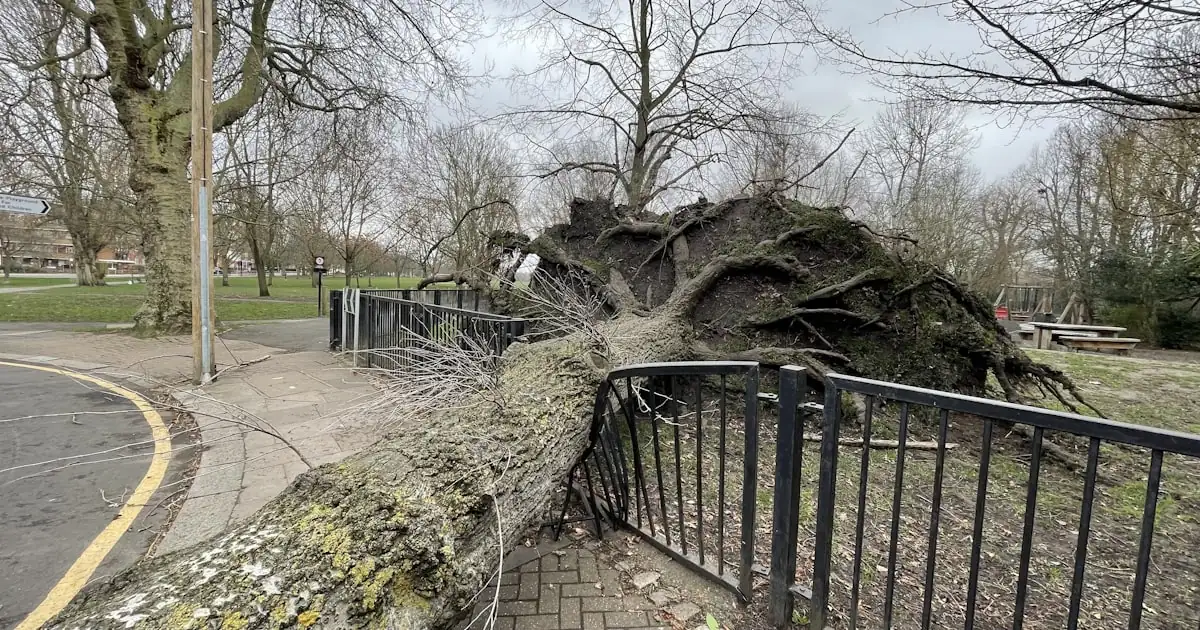
Atlantic hurricane season runs June 1 through November 30 every year. The American Society of Civil Engineers’ 2025 Infrastructure Report Card graded U.S. solid-waste infrastructure at C+ — meaning the system is functional but stressed, with limited slack for major weather events. Storm response in the BR metro is a known weak spot for fleet-wide national-hauler operations. Regional dispatch typically adds 24-72 hours of coordination time after the all-clear.
Local haulers have a structural advantage on storm response that has nothing to do with marketing. Their drivers live in the parishes they serve — they’re not being deployed from another state. Their trucks are already on the right side of the surge zone. Their dispatchers don’t have to coordinate with three other regional offices to authorize a route change. After the all-clear, they’re often back on the road within 24-48 hours rather than waiting on a regional escalation cycle.
There’s a separate problem on the customer side: cart contents change radically after a storm. Yard debris, broken fencing, water-damaged drywall, ruined furniture. None of that fits the route truck’s collection cycle. A good hauler will tell you up front what fits in the cart, what needs a bulk pickup, and what counts as FEMA-eligible debris when there’s a federal disaster declaration — because the categories matter and the wrong category gets your debris sitting on the curb until next year. A less-attentive hauler ghosts on that conversation.
Photograph any damaged carts before storm pickup, with the date visible. Cart-replacement disputes go faster when you have evidence of pre-existing damage versus storm damage.
For the practical detail on storm debris — what counts as what, how the FEMA categories work, when to bulk-schedule versus wait for the regular route — see our hurricane season debris cleanup guide for Ascension and Livingston homeowners.
Frequently Asked Questions
Who picks up residential trash in Ascension and Livingston Parishes?
Residential trash service in Ascension and Livingston Parishes is provided by independent local operators rather than a single parish contractor. Each household chooses its own hauler. Trash Rangers serves 22 locales across the two parishes, including Prairieville, St. Amant, Geismar, Sorrento, Donaldsonville, Denham Springs, Walker, Watson, and Albany. In neighboring East Baton Rouge Parish, by contrast, Republic Services holds the parish contract through 2033 — a transition WAFB documented in its July 2023 rollout coverage.
How much does residential trash service cost in Ascension or Livingston Parish?
Rates vary by hauler, service tier, and cart size. The right benchmark is the contracted EBR rate next door: $35.23 per month, up from $23 before March 2023, escalating 4% annually under a contract that runs through 2033. WBRZ’s coverage of the parish’s new garbage contract lays out the full progression. Local providers in Ascension and Livingston typically compete on service quality and response time rather than undercutting the contracted rate by huge margins.
Can I switch trash service providers in Ascension or Livingston Parish?
Yes. Ascension and Livingston Parish residents — and property managers handling rentals in either parish — can switch providers without waiting for a contract cycle. The process takes about a week and involves coordinating cart pickup and drop-off between the outgoing and incoming haulers. The situation is different in East Baton Rouge Parish, where residential service is bundled into the parish contract and switching isn’t an available option until 2033.
What day is my trash pickup in Prairieville, Walker, or my locale?
Pickup days vary by neighborhood and by provider. For the current Trash Rangers schedule across all 22 served locales in Ascension and Livingston Parishes, see the Trash Rangers pickup schedule page. Residents under a different provider should check that company’s website or call their customer-service line for the current day-of-week assignment.
Why does the Baton Rouge area have so many missed pickups?
Most of the documented missed-pickup pattern sits in East Baton Rouge Parish. The Advocate’s 2019 reporting on EBR garbage service documented nearly 6,000 missed-garbage and roughly 1,000 missed-recycling 311 complaints in 2018 alone — a pattern that prompted the parish to invite contract re-bids and Republic Services to apologize publicly in June 2019. The structural causes are route density and driver continuity at fleet-wide scale. Local haulers in Ascension and Livingston don’t have that same scale problem.
The bottom line for Ascension and Livingston residents
Ascension and Livingston Parishes together hold roughly 283,000 residents across 22 TR-served locales. Unlike neighboring East Baton Rouge — where the parish contract sets the rate and the rate keeps rising 4% a year — Ascension and Livingston residents choose their own hauler. That choice is the thing worth using carefully.
The documented EBR missed-pickup pattern — roughly 7,000 311 complaints in 2018 alone — isn’t ancient history. It’s the operational track record under which the current EBR contract was renewed in 2022, and it’s the reason your ability to choose in Ascension or Livingston actually matters. Local haulers compete on route knowledge, response time, and accountability, not on fleet scale. Use the five-question framework above when you evaluate any provider.
If you’re ready to talk through what local trash service in your specific Ascension or Livingston neighborhood looks like, Trash Rangers covers 22 locales across Ascension Parish and Livingston Parish — see the full service-area map or jump straight to a city page like Prairieville, Walker, or Denham Springs. You can start residential service here.
About the author
Jake Poche — Owner, Trash Rangers. Trash Rangers of Louisiana, LLC is a Baton Rouge-area waste services company serving residential trash collection, commercial dumpster rental, and event sanitation across Ascension Parish, East Baton Rouge, and the surrounding parishes. The company is registered as a Louisiana State Contractor (License #71067), holds an A+ BBB rating, and has been operating since August 2020. Learn more about the company at trashrangersllc.com or get in touch through the contact page.